You have rested it. You have stretched it. You have tried new shoes, foam rolled every evening, and taken ibuprofen on race day. And it still comes back. The same knee. The same heel. The same hip flexor. Every time you build your mileage past a certain point, the same structure gives way.
This is not bad luck. It is a pattern. And patterns in running injuries almost always have a mechanical explanation.
The way you run, specifically how your foot contacts the ground, how your knee tracks, how your hip drops, and how your trunk rotates, determines which structures carry the most load with every stride. At 40 miles per week that is approximately 70,000 footstrikes on each foot. A small mechanical inefficiency repeated 70,000 times is not small at all. It is a guaranteed injury pathway.
A gait analysis in Blackburn at Premier Clinic identifies that pattern. This article explains how, and what happens when the analysis finds the problem your previous treatment missed.
The Most Common Running Injuries and the Gait Patterns That Drive Them
Most running injuries are not random. Each common injury has a set of biomechanical risk factors that research has consistently associated with it. Understanding which pattern is driving your injury is the first step toward actually fixing it rather than managing it.
Knee Pain When Running: Runner’s Knee and IT Band Syndrome
Patellofemoral pain, called runner’s knee, is the most common running injury. The kneecap sits in a groove in the femur and glides through it as the knee bends and straightens. When the soft tissue structures around the knee are not balanced, the kneecap tracks abnormally within that groove, creating friction and pain. The most common biomechanical driver is excessive foot pronation producing tibial internal rotation, which pulls the patella medially. Hip abductor weakness compounds this by allowing the hip to drop during single-leg stance, increasing knee valgus and patellar stress.
IT band syndrome produces pain on the outer side of the knee and is similarly driven by hip weakness and gait mechanics. Runners whose hips drop excessively during the stance phase place repetitive tension on the iliotibial band as it crosses the knee. The pain is caused by gait, not by the IT band itself, which is why foam rolling the band in isolation produces temporary relief at best.
Hip Pain When Running: Gluteal Tendinopathy and Hip Flexor Strain
Hip pain in runners most commonly involves the gluteal tendons on the outer hip or the hip flexor complex at the front of the hip. Gluteal tendinopathy is driven by compressive loads on the tendon, which occur when the hip adducts in excess during the stance phase of gait. This is the same hip drop pattern that drives runner’s knee, which is why the two injuries frequently co-exist in the same runner. Hip flexor strain is typically a load management problem, but the mechanics of how a runner extends the hip during the late stance phase determine the tissue stress. An overstriding pattern that produces a long, low-impact footstrike in front of the body loads the hip flexors differently to a well-positioned footstrike beneath the body’s centre of mass.
Foot Pain When Running: Plantar Fasciitis and Metatarsalgia
Plantar fasciitis is the running world’s most persistent injury. The plantar fascia, the thick band of tissue running from the heel to the toes, absorbs enormous load during running. When the foot mechanics increase the strain at the fascia’s heel insertion, the repetitive loading exceeds the tissue’s capacity to adapt and breakdown occurs. Excessive pronation, a flat arch, and restricted ankle dorsiflexion are the three most common biomechanical contributors. Metatarsalgia, pain in the ball of the foot, typically reflects elevated forefoot pressure during the propulsive phase, which a pressure plate footscan quantifies precisely.
Shin Splints and Stress Fractures
Medial tibial stress syndrome, commonly called shin splints, is caused by repetitive bending stress in the tibia. The magnitude of that bending stress is directly influenced by how the foot loads the ground. Excessive and rapid pronation generates higher tibial bending forces with each footstrike. A runner whose foot collapses inward rapidly on landing is generating more tibial stress per mile than a runner with controlled mechanics, even at the same pace and volume. When tibial bending stress exceeds the bone’s remodelling capacity, the result is first a stress reaction and then a stress fracture.
Achilles Tendinopathy
The Achilles tendon is under highest rotational stress at the heel-lift phase of gait, when the foot transitions from pronation to supination during propulsion. Runners who overpronate impose higher rotational torque on the tendon at this critical moment. The clinical consequence is collagen disruption in the midportion of the tendon that presents as the classic Achilles tendinopathy: pain in the morning after rest, pain at the beginning of a run that often settles midway through, and then a gradual worsening as training volume increases.
Every injury described above has a biomechanical contributor that a gait analysis identifies. In many cases, runners have been treated for the tissue problem without anyone ever assessing the mechanical pattern that keeps recreating it. Addressing the tissue without the mechanics produces recovery followed by relapse, not resolution.
What a Running Gait Analysis at Premier Clinic Blackburn Involves
Premier Clinic’s running clinic and biomechanics service in Blackburn provides a full clinical gait analysis, not a retail shoe assessment. There is a meaningful difference. A free gait analysis at a running shop produces a shoe recommendation. A clinical gait analysis at Premier Clinic produces a diagnosis, a biomechanical report, and a treatment plan.
Clinical History and Injury Assessment
The assessment begins with a detailed discussion of your training history, the nature and onset of your injury, what makes it better and worse, what you have already tried, and what your running goals are. This history frequently points toward the cause before the physical examination begins. A runner who always injures the same leg, whose symptoms worsen as weekly mileage increases, and who has a history of wearing shoes down on the outer heel is already providing biomechanical data.
Musculoskeletal Examination
A physical examination assesses foot posture and arch structure, ankle range of motion, hip strength and mobility, leg length, and any structural findings relevant to the injury. Specific clinical tests assess the integrity of the tissues involved in the injury and identify any muscular weaknesses that contribute to the gait pattern.
Video Gait Analysis at Running Speed
The runner walks and runs on a treadmill while video analysis captures movement from the front and side at multiple camera angles. The clinician assesses foot strike pattern, the rate and degree of pronation, tibial rotation, knee valgus angle, hip drop during single-leg stance, trunk lean, arm swing, and cadence. Running gait captures information that walking gait does not, because the forces involved are two to three times higher and movement patterns that are controlled at walking speed often break down at running speed. This is why a clinical gait analysis at Premier Clinic captures running data, not just walking data.
Force Plate and Dynamic Footscan
For runners being assessed for custom orthotic prescription, a dynamic footscan using force plate technology captures real-time pressure distribution during the footstrike cycle. The result is a pressure map showing exactly where the foot loads the ground, when, and with how much force. This data drives the Phits orthotic prescription and is far more clinically relevant than a static foam box impression of the foot at rest.
Biomechanical Report and Treatment Plan
Following the assessment, a written biomechanical report is produced. The report identifies the specific gait parameters contributing to the injury, quantifies them where possible, and proposes a structured treatment plan. The plan specifies which interventions are indicated, the order in which they should be implemented, and the expected timeline for each stage of recovery and return to running.
What Gait Analysis Finds in Runners: The Most Common Patterns
| Gait Pattern | What It Means | Injury It Drives | Intervention |
| Excessive pronation | Foot collapses inward too far or too fast after heel contact | Plantar fasciitis, runner’s knee, Achilles tendinopathy, shin splints | Custom orthotics, footwear assessment, hip strengthening |
| Contralateral hip drop | Pelvis drops on the non-stance side during single-leg support | IT band syndrome, gluteal tendinopathy, runner’s knee | Hip abductor strengthening, gait retraining |
| Knee valgus on loading | Knee collapses inward during stance phase | Patellofemoral pain, IT band syndrome | Hip and glute strengthening, orthotics, gait retraining |
| Overstriding | Foot lands well ahead of centre of mass | Shin splints, hip flexor strain, knee pain | Cadence increase, gait retraining, run technique work |
| Heel whip | Foot swings outward or inward during swing phase | Knee pain, IT band syndrome, hip pain | Hip mobility work, gait retraining |
| Reduced ankle dorsiflexion | Ankle cannot flex sufficiently, forcing compensation | Plantar fasciitis, Achilles tendinopathy, knee pain | Calf stretching and loading programme, heel raise in orthotics |
| Asymmetric arm swing | One arm crosses the midline, rotating the trunk | Lower back pain, hip pain, shoulder pain during running | Run technique correction, core stability work |
| Low cadence | Fewer steps per minute, longer ground contact time, more impact | Shin splints, stress fractures, knee pain | Metronome-based cadence training, gait retraining |
How Gait Problems Are Treated at Premier Clinic Blackburn
Identifying a gait problem is the first step. Correcting it requires specific interventions that address the specific pattern. At Premier Clinic, the following treatments are available on the same site and are co-ordinated as a single programme.
Custom Orthotics for Runners
Where foot mechanics contribute to the injury, custom orthotics address the problem at its source. Premier Clinic prescribes Phits 3D-printed orthotics, produced from dynamic footscan data to a tolerance of 0.1mm by Materialise, the world leader in medical 3D printing. Unlike cast-based orthotics that record a static foot position, Phits orthotics are designed from data captured during actual gait, which is more clinically relevant for runners whose foot mechanics change significantly under load.
Running-specific orthotic variants are available for road and trail running shoes, football boots, cycling cleats, and other sport-specific footwear. The prescribing podiatrist specifies material, density, design profile, and top cover based on the gait analysis findings and the patient’s training demands.
Physiotherapy and Targeted Strengthening
Most gait problems in runners have a muscular weakness component. Hip abductor and gluteal weakness is among the most common, and it directly drives multiple injury patterns including IT band syndrome, runner’s knee, and gluteal tendinopathy. The physiotherapy service at Premier Clinic designs a targeted strengthening programme based on the specific weaknesses identified during the gait assessment. This is not a generic hip strengthening programme. It is a programme specific to the muscles that are weak in this runner, causing this gait pattern, producing this injury.
Shockwave Therapy for Chronic Tissue Damage
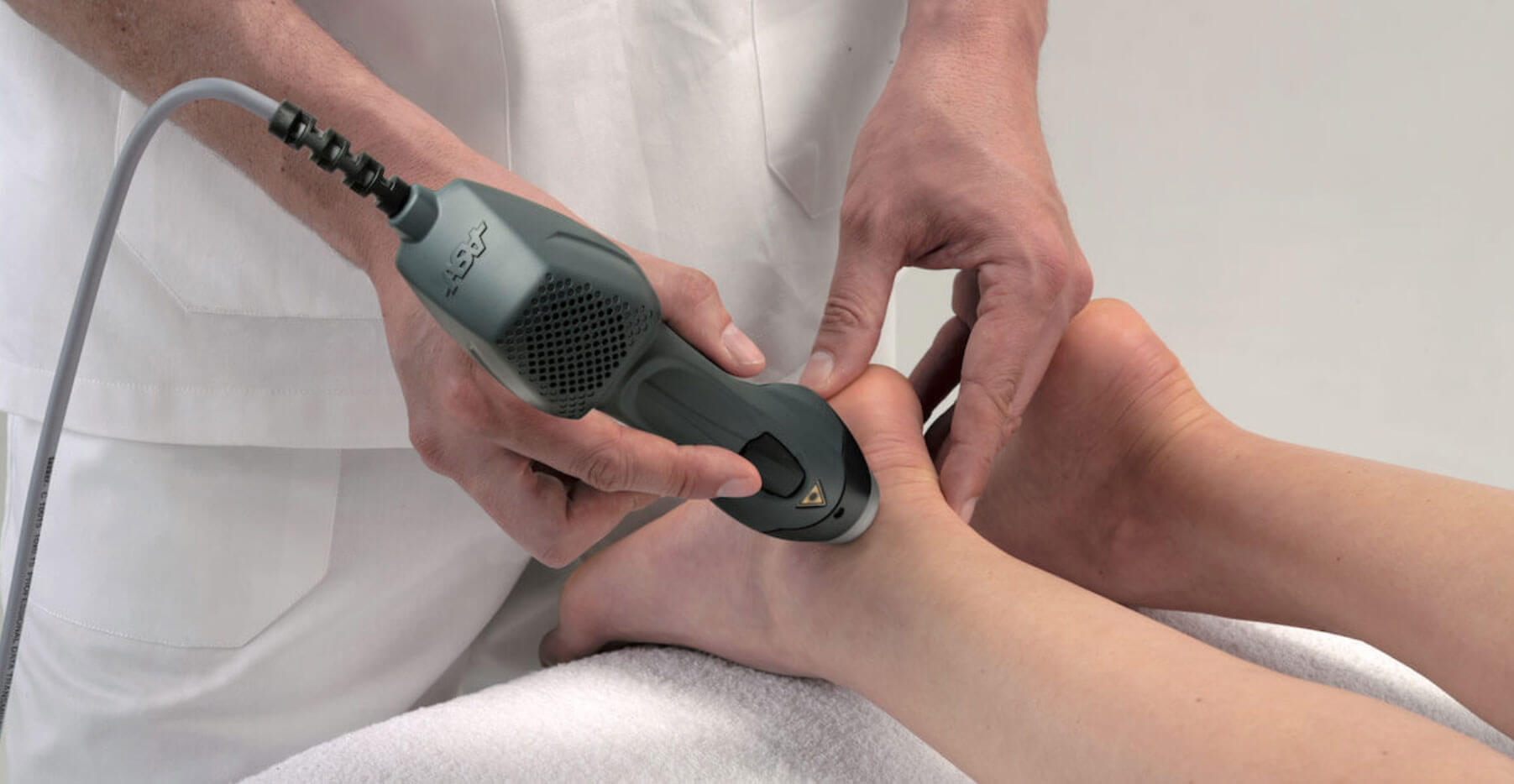
Runners who have been managing the same tendon injury for weeks or months often have chronic tissue changes that require more than load management and strengthening to resolve. Shockwave therapy at Premier Clinic stimulates cellular repair in chronically degenerated tendon tissue, accelerating the biological repair process alongside the mechanical correction of the gait pattern driving the injury. Both radial and focused shockwave are available, with the prescribing clinician selecting the appropriate technology based on the location and nature of the tissue pathology.
Sports Massage for Soft Tissue Recovery
Running injuries typically produce secondary soft tissue adaptations: tight calf muscles, tensor fasciae latae hypertonicity, inhibited glutes, and fascial restrictions that develop as the body compensates around the injured structure. Sports massage at Premier Clinic addresses these secondary changes, reducing tissue tension that would otherwise limit the effectiveness of the strengthening programme and gait retraining.
AlterG Treadmill for Maintaining Fitness During Recovery
One of the most common and legitimate fears runners have about injury is losing fitness during recovery. For runners with stress fractures, plantar fascia tears, or post-surgical lower limb conditions, complete rest from running means cardiovascular deconditioning that can take months to recover. Premier Clinic’s AlterG Anti-Gravity Treadmill solves this directly. By reducing effective body weight to as little as 20% during treadmill running, the AlterG allows injured runners to continue training at meaningful aerobic intensities while the healing tissue is protected from the full mechanical loads that caused the injury. Premier Clinic is one of the only clinics in Lancashire with this equipment on site.
Gait Retraining
Where the gait problem involves movement patterns that orthotics and strengthening alone cannot fully correct, structured gait retraining is used. This involves the runner practising modified movement patterns with real-time feedback from video analysis until the new pattern becomes automatic. Common retraining targets include increasing cadence, reducing overstriding, limiting contralateral hip drop, and improving forward lean. Return-to-running protocols are designed through the running clinic and combined with the rehabilitation programme to guide the runner back to full training volume safely.
Signs Your Running Pain Is a Gait Problem, Not Just a Tissue Problem
- The same injury keeps returning in the same location despite rest and previous treatment
- Pain only occurs above a certain weekly mileage threshold
- The injury is always on the same side of the body
- You wear your running shoes down faster on one side or in a consistent unusual pattern
- You have had the same injury diagnosed and treated by multiple clinicians without lasting resolution
- Your symptoms are worse on certain terrain or surface types
- Friends or other runners have commented on something unusual about the way you run
- You have changed shoes multiple times to address the problem without success
- Your injury returns every time you increase training load toward a race
If three or more of the above apply to you, your injury almost certainly has a gait or biomechanical component that has not been assessed. Managing the tissue without assessing the mechanics that are breaking it down is not a treatment. It is a maintenance programme for a problem that will continue indefinitely until the cause is addressed.
Sports Podiatry in Blackburn: The Role of the Foot in Running Injuries
Sports podiatry is the discipline that sits at the intersection of foot function and athletic performance. A sports podiatrist does not simply treat foot pain. They assess how the foot mechanics during running and sport interact with the entire lower limb kinetic chain, and they intervene to correct patterns that are driving injury above and below the foot.
At Premier Clinic, the sports podiatry service is led by Shaun Kelly, who holds a Masters-level qualification in musculoskeletal medicine, sports podiatry, and biomechanics, with over 20 years of post-graduate clinical experience. The combination of podiatric training and musculoskeletal medicine means that the assessment spans from the foot mechanics to the hip and spine, rather than stopping at the ankle.
Sports podiatry at Premier Clinic covers:
- Running gait analysis and biomechanical assessment
- Custom sports orthotics using Phits 3D technology and force plate data
- Footwear assessment and recommendations specific to the runner’s foot type and gait
- Sport-specific orthotic prescription for road running, trail running, football, cycling, and other sports
- Foot and lower limb injury assessment and treatment
- Swift verruca treatment for runners who cannot afford downtime from skin lesion management
- Nail and skin conditions common in runners, including subungual haematoma and friction blisters
Frequently Asked Questions: Running Gait Analysis in Blackburn
Q: How do I know if my running injury is caused by my gait?
A: The clearest indicators are that the same injury keeps returning in the same location, that it comes back every time you increase your training load, that it is always on the same side, and that previous treatment has produced temporary improvement but not lasting resolution. Any of these patterns suggests that the mechanical cause of the injury has not been identified or addressed. A gait analysis at Premier Clinic Blackburn will identify whether your running mechanics are contributing to the problem.
Q: What does a running gait analysis at Premier Clinic Blackburn involve?
A: The assessment includes a clinical history and injury review, a musculoskeletal examination of the foot, ankle, knee, hip, and pelvis, video gait analysis at both walking and running speed from multiple angles, and where custom orthotics are being considered, a dynamic footscan using force plate technology. The assessment produces a written biomechanical report and a personalised treatment plan. Appointments are typically available within one week and no GP referral is needed.
Q: Can custom orthotics fix running knee pain?
A: Custom orthotics can be a significant part of the solution for runner’s knee when excessive foot pronation is driving the tibial rotation and knee valgus that produces patellofemoral pain. They are rarely the complete solution on their own. Most runners with knee pain also need a targeted hip strengthening programme to address the weakness that allows knee valgus to occur. At Premier Clinic, orthotics and physiotherapy are co-ordinated as part of a single treatment plan rather than implemented in sequence by separate providers.
Q: How long does it take to fix a running gait problem?
A: Orthotic prescription produces changes in ground contact mechanics from the first use. Strength improvements from a targeted rehabilitation programme typically become functionally significant within six to eight weeks. Gait retraining to change habitual movement patterns takes longer and is typically consolidated over ten to sixteen weeks of consistent practice. The timeline for return to full training volume depends on the nature and duration of the injury as well as the severity of the gait problem. Premier Clinic provides a realistic timeline at the initial assessment and reviews it as recovery progresses.
Q: Is Premier Clinic’s running gait analysis different from a free gait analysis at a running shop?
A: Yes, significantly. A running shop gait assessment is a retail process designed to recommend footwear. It is performed by sales staff, not clinicians, typically lasts five to ten minutes, and produces a shoe recommendation. A clinical gait analysis at Premier Clinic is conducted by an HCPC-registered podiatrist with specialist biomechanics training, includes a full musculoskeletal examination, uses force plate and video technology, and produces a clinical report with a structured treatment plan. The two processes are not comparable.
Q: Do I need a GP referral for a running gait analysis in Blackburn?
A: No. Premier Clinic operates a self-referral model for all biomechanics, running clinic, and sports podiatry services. Call 01254 677341 or email info@premier-clinic.co.uk to book directly.
Book Your Running Gait Analysis at Premier Clinic Blackburn
If the same knee, hip, or foot problem keeps interrupting your running, the answer is almost certainly not more rest, more foam rolling, or a different pair of shoes. The answer is finding out why that specific structure keeps failing under the specific demands of your running, and then changing the mechanical environment that keeps breaking it down.
Premier Clinic at Lions Drive, Blackburn provides running gait analysis, sports podiatry, biomechanics assessment, custom orthotics, physiotherapy, shockwave therapy, and AlterG rehabilitation from one site, with one clinical team. No GP referral needed. Appointments available within the week. Saturday mornings available.
Call 01254 677341 or email info@premier-clinic.co.uk to book your running gait analysis. Premier Clinic is at 11 Cunningham Court, Lions Drive, Shadsworth Business Park, Blackburn BB1 2QS. Open Monday to Friday 9am to 6pm and Saturday 9am to 1pm. Free parking on site.