Author: Premier Clinic
The Turbomed Brace for Drop Foot: How It Works and Who It Helps
If you catch your toes on the pavement, trip on stairs you have climbed a thousand times, or find yourself lifting your knee unnaturally high just to clear the ground when you walk, you may be living with foot drop. It is a frustrating condition, not because it is rare, but because so few people are told there is a brace built specifically to let them walk, run and climb stairs again without compromise. The Turbomed brace is one of those options, and at Premier Clinic in Blackburn, our podiatry and physiotherapy team fit and assess patients for it as part of a wider approach to mobility and rehabilitation.
This guide explains what foot drop is, how the Turbomed brace works, who it tends to suit, and what to expect if you come to our clinic on Lions Drive for an assessment.
What Is Foot Drop and What Causes It?
Foot drop is the inability to lift the front part of your foot and toes properly when you walk. It happens when the muscles that pull your foot upward are weakened or affected by nerve damage. According to the NHS, the most common cause is an injury to a nerve running down the leg that controls those muscles, though the underlying reason varies a great deal from person to person.
People with foot drop often develop a “steppage gait,” where the knee is lifted higher than normal to stop the toes catching the ground. Over time this changes posture, increases fall risk, and puts strain on the hip and lower back on the affected side.
Common Causes of Foot Drop
| Cause | What Is Happening |
| Peroneal nerve injury | Compression or damage to the nerve as it passes near the knee, often from prolonged crossed legs, a cast, or trauma |
| Stroke | Nerve signal disruption between the brain and leg muscles |
| Multiple sclerosis | Damage to nerve pathways affecting coordination between brain and ankle |
| Lumbar radiculopathy | A pinched nerve root in the lower spine, often linked to a slipped disc |
| Charcot Marie Tooth disease | An inherited condition affecting peripheral nerves |
| Post surgical nerve irritation | Temporary or lasting nerve involvement following hip, knee or spinal surgery |
| Diabetes related neuropathy | Long term nerve damage affecting sensation and muscle control in the feet |
If you notice new or worsening foot drop, this should always be assessed by a GP or specialist first, since it is usually a sign of an underlying condition that needs proper diagnosis.
What Is the Turbomed Brace?
The Turbomed brace is a type of ankle foot orthosis, commonly shortened to AFO. Unlike traditional AFOs, which sit inside the shoe against the skin, the Turbomed is fitted to the outside of the shoe. This single design choice solves two problems that patients frequently raise with conventional braces: skin irritation from rubbing, and the bulk of trying to fit a brace and a normal shoe together.
How the Turbomed Brace Works
The brace uses a spring loaded hinge mechanism that sits against the back of the calf and clips onto the shoe near the heel. As you walk, the spring lifts the front of the foot during the swing phase of your stride, so your toes clear the ground naturally instead of catching or dragging.
Importantly, the mechanism is designed to allow a much fuller range of ankle motion than many rigid braces. As explained on our Turbomed brace service page, the design does not block the ankle from moving upward or downward the way many other AFOs do, which is part of why patients often find it more comfortable on slopes, stairs and uneven ground.
Because it clips onto the outside of the shoe rather than being built into it, the same brace can generally be moved between different pairs of shoes, which matters for anyone who wants to wear the same brace with trainers one day and boots the next.
Turbomed Brace vs Traditional AFO Braces
| Feature | Turbomed Brace | Traditional Rigid AFO |
| Fitting position | Outside the shoe | Inside the shoe, against the skin |
| Ankle movement | Allows natural plantarflexion and dorsiflexion | Often restricts ankle movement to stabilise the joint |
| Skin contact | Minimal, reduces rubbing and skin breakdown | Direct contact, higher risk of irritation |
| Switching shoes | Can generally be moved between suitable shoes | Usually built for one pair of shoes |
| Best suited to | Active patients wanting to walk, hike or run | Patients needing maximum joint stabilisation |
| Visibility | Sits outside the shoe, more visible | Hidden inside the shoe |
Neither option is universally “better.” Which brace suits you depends on the cause and severity of your foot drop, your activity level, and what your assessment shows.
Who Is the Turbomed Brace Suitable For?
Because it prioritises range of motion and comfort during activity, the Turbomed brace tends to suit patients who:
- Have mild to moderate foot drop from a peroneal nerve injury, stroke, MS, or a spinal nerve issue
- Want to stay active, including walking, hiking, gym work or light running
- Have struggled with rubbing, blistering or skin breakdown from a traditional AFO
- Move between different types of footwear regularly, such as trainers, work boots or walking boots
- Have reasonably preserved ankle stability and do not require maximum rigid support
It is generally less suitable for patients with significant ankle instability, severe spasticity, or a foot and ankle deformity that needs a fully customised, moulded brace. This is exactly why an in person assessment matters rather than ordering a brace based on a diagnosis alone. Two people with the same underlying condition can have very different biomechanics, and the right brace has to match the individual, not just the label.
Benefits of the Turbomed Brace for Everyday Life
Patients who are fitted appropriately often notice practical, day to day differences rather than dramatic ones:
Fewer trips and stumbles. By lifting the toes during the swing phase of walking, the brace reduces the catching and dragging that causes falls.
More natural movement on stairs and slopes. Because the hinge allows the ankle to move rather than locking it rigid, many patients find uneven ground, kerbs and stairs noticeably easier to manage.
Comfort over longer periods. Sitting outside the shoe means less direct skin contact, which matters for anyone who has previously given up on a brace because of soreness or blistering.
Flexibility across footwear. Being able to move the brace between shoes suits people who need to wear safety boots for work, then trainers for the rest of the day.
Confidence to stay active. For many patients, the biggest benefit is not medical, it is being able to keep walking the dog, get back to the gym, or manage a hike without foot drop dictating the plan.
What to Expect at Your Turbomed Brace Assessment at Premier Clinic
If you come to Premier Clinic in Blackburn for a Turbomed brace assessment, the process is built around understanding your walking pattern before fitting anything.
Step 1: Assessment and history. Our team will ask about the cause and duration of your foot drop, any previous bracing you have tried, and what activities matter most to you, whether that is walking the dog, getting back to work, or returning to sport.
Step 2: Gait and biomechanical review. We look at how you walk, where your foot catches or drags, and how your ankle, knee and hip are compensating. This is often combined with our wider biomechanics assessment approach, since foot drop rarely affects the ankle in isolation.
Step 3: Fitting. The brace is fitted to your own footwear where possible, so you can feel the difference in your actual walking pattern rather than a generic in clinic shoe.
Step 4: Review and adjustment. Bracing is rarely perfect on day one. We check comfort, fit and function, and make adjustments as needed.
Step 5: Ongoing support. Because foot drop is often linked to a wider condition, our team can coordinate the brace alongside physiotherapy or podiatry care where that is appropriate, rather than treating the brace as a standalone fix.
Turbomed Brace vs Other Foot Drop Treatments in Blackburn
| Treatment Option | What It Involves | Best For |
| Turbomed brace | External, hinged AFO fitted outside the shoe | Active patients wanting mobility and comfort |
| Traditional rigid AFO | Internal, moulded brace fitted inside the shoe | Patients needing maximum stabilisation |
| Functional electrical stimulation (FES) | Small electrical impulses stimulate the nerve to lift the foot | Patients suited to nerve stimulation rather than bracing |
| Physiotherapy and strengthening | Targeted exercise to improve muscle control and gait | Mild cases or as a complement to bracing |
| Custom orthotics | Insoles addressing alignment rather than the drop itself | Supporting biomechanics alongside a brace |
These approaches are not mutually exclusive. Many of our patients use a Turbomed brace alongside a structured physiotherapy programme, since strengthening work and bracing support different parts of the same problem.
Why Choose Premier Clinic for Your Turbomed Brace in Blackburn
Premier Clinic is based on Lions Drive, Shadsworth Business Park in Blackburn, BB1, and serves patients across Blackburn, Darwen, Accrington and the wider Lancashire area. A few things shape how we approach foot drop and bracing specifically:
HCPC registered clinicians. Our podiatry and physiotherapy team are registered professionals, so assessments are grounded in a proper clinical evaluation rather than a generic fitting.
Multidisciplinary care under one roof. Because foot drop often sits alongside a wider neurological or musculoskeletal condition, having podiatry, physiotherapy and rehabilitation support in one clinic means your brace is not treated in isolation from the rest of your recovery.
A personal, unhurried approach. Bracing decisions are rarely one size fits all, and we would rather take the time to get the fit and function right than rush a patient into a brace that ends up in a drawer within a month.
Frequently Asked Questions
Is the Turbomed brace available on the NHS?
Availability varies by area and is usually assessed through NHS orthotics or neurology services. Many patients choose a private assessment, such as at Premier Clinic, for faster access, a wider choice of brace options, or when NHS provision does not suit their needs.
Can I wear the Turbomed brace with my own shoes?
In many cases, yes. The brace is designed to fit onto the outside of a shoe rather than being built into one, so it can often be moved between suitable pairs, though this depends on the shoe type and will be confirmed at your fitting.
Will the brace stop my foot drop from getting worse?
A brace supports your walking pattern and reduces the risk of trips and falls, but it does not treat the underlying cause. If your foot drop is linked to a condition such as MS or a spinal issue, ongoing management of that condition matters alongside bracing.
How long does it take to get used to wearing it?
Most patients need a short adjustment period, often a couple of weeks of regular wear, before the brace feels natural. Our team will check in during this period and make adjustments if anything feels wrong.
Is the Turbomed brace suitable for running or sport?
For many patients with mild to moderate foot drop, yes, the design is intended to support more active movement than a rigid brace typically allows. Suitability depends on your individual assessment, so this is confirmed on a case by case basis rather than assumed from the diagnosis alone.
Getting Started
Foot drop can feel like it quietly shrinks your world, fewer walks, more caution on stairs, constant awareness of where your foot is about to catch. A well fitted brace will not remove the underlying cause, but for the right patient it can hand back a lot of that confidence.
If you are in Blackburn or the wider Lancashire area and want to know whether the Turbomed brace is right for your situation, contact Premier Clinic on 01254 677341 or request an appointment with our podiatry and physiotherapy team.
Who Treats Ligament Injuries in Blackburn, Lancashire?
| Joint | Common Ligament Injuries | Typical Cause |
| Knee | ACL, PCL, MCL, LCL sprain or rupture, multi-ligament knee injury | Pivoting, contact sport, landing, skiing |
| Ankle | Lateral ankle sprain (ATFL, CFL), high ankle sprain (syndesmosis), medial deltoid ligament | Rolling the ankle, running on uneven ground, court and field sports |
| Shoulder | Acromioclavicular (AC) joint sprain, glenohumeral ligament injury, shoulder dislocation | Contact sport, fall onto outstretched arm, overhead impact |
| Wrist and thumb | Scapholunate ligament injury, ulnar collateral ligament (skier’s thumb) | Fall onto hand, ball sports, skiing |
| Hip | Hip labral tear, iliofemoral ligament sprain | Cutting movements, repetitive hip flexion, direct impact |
| Elbow | UCL sprain, LCL complex injury | Throwing sports, valgus stress, elbow dislocation |
| Finger | Collateral ligament sprain, volar plate injury | Ball striking, hyperextension, direct contact |
Ligament Injury Grades: What Each Means for Treatment
Ligament injuries are classified by grade, which reflects the proportion of fibres damaged and the degree of joint instability produced. Understanding the grade is essential for determining whether surgery is needed, how long rehabilitation will take, and what restrictions apply in the early phases of treatment.
Grade One: Ligament Sprain
A Grade One sprain involves stretching of the ligament with minor micro-tearing of individual fibres. The joint remains stable. There is localised tenderness and mild swelling but the patient can usually bear weight and maintain functional movement. Recovery with appropriate physiotherapy and load management is typically two to four weeks.
Grade Two: Partial Ligament Tear
A Grade Two injury involves significant tearing of ligament fibres with partial disruption of the ligament structure. There is moderate pain, swelling, and bruising, and the joint may feel unstable or give way under load. Recovery takes six to twelve weeks depending on the joint and the patient’s activity demands. Physiotherapy to restore proprioception, strength, and controlled return to loading is essential to avoid the joint instability that frequently leads to re-injury.
Grade Three: Complete Ligament Rupture
A Grade Three injury is a complete rupture of the ligament. The joint is structurally unstable and the patient is typically unable to weight-bear or function normally through the affected joint. Treatment depends on the joint, the patient’s age, activity level, and functional demands. Some Grade Three injuries, including many MCL ruptures and lateral ankle ligament tears, are managed conservatively with immobilisation followed by structured rehabilitation. Others, including ACL ruptures in active patients, typically require surgical reconstruction followed by a nine to twelve month rehabilitation programme.
A ligament injury that is not properly rehabilitated produces a joint that is weaker, less stable, and less capable of detecting positional changes quickly. This is why re-injury rates for inadequately rehabilitated ankle sprains and ACL injuries are so high. The ligament may heal. The proprioceptive and neuromuscular deficits that predispose to re-injury do not resolve without targeted rehabilitation.
Ligament Injury Physiotherapy in Blackburn: What Treatment Involves at Premier Clinic
Initial Assessment and Diagnosis
Every ligament injury patient at Premier Clinic begins with a structured clinical assessment. The physiotherapy assessment covers the mechanism of injury, the patient’s functional status, orthopaedic testing to confirm the specific ligament involved and assess joint stability, and where imaging is indicated to confirm the injury grade, the on-site private GP can arrange ultrasound or MRI through the private imaging pathway on the same visit. A clinical diagnosis is established before any treatment is applied.
Phase One: Protection and Acute Management (Days One to Seven)
The immediate priority following ligament injury is protecting the damaged structure while managing pain and swelling, maintaining circulation, and preventing unnecessary stiffness in adjacent joints. Depending on the injury grade and joint, this may involve a period of protected weight-bearing, bracing, or restricted range of motion.
Premier Clinic’s physiotherapy team advises on appropriate protection, prescribes early gentle range-of-motion exercises within permitted limits, and begins gentle activation of the muscle groups most important for joint protection. For lower limb ligament injuries where weight-bearing is restricted, the AlterG Anti-Gravity Treadmill allows protected mobility from the earliest stage of recovery. Soft tissue massage around the injury, avoiding the acute injury site initially, reduces secondary muscular tension and improves local circulation.
Phase Two: Restoring Mobility and Early Strength (Weeks Two to Six)
As swelling settles and the ligament enters the early repair phase, the rehabilitation programme introduces progressive range-of-motion exercises, closed-chain strengthening, and the beginning of proprioception retraining. Proprioception, the joint’s ability to sense its own position and respond to perturbation, is directly disrupted by ligament injury because the mechanoreceptors within the ligament are damaged alongside the collagen fibres. Restoring proprioception is not optional. It is the single most important factor in preventing re-injury.
Phase Three: Strength, Function, and Sport-Specific Conditioning (Weeks Six to Twelve or Beyond)
The later phases of ligament rehabilitation focus on progressive strength training, advanced proprioception and balance challenges, and the introduction of sport-specific movement patterns. For athletes, this phase includes plyometric training, agility drills, and return-to-sport functional testing. For patients returning to physically demanding occupations, it includes functional capacity assessment aligned to the specific task demands.
Where biomechanical factors contributed to the original ligament injury, Premier Clinic’s biomechanics and orthotics service addresses these during the rehabilitation programme to reduce re-injury risk. An ankle that keeps spraining because of foot supination and lateral loading bias needs custom orthotic support alongside the proprioceptive rehabilitation programme to address the mechanical environment that keeps creating instability.
ACL Ligament Injury Rehabilitation in Blackburn
ACL reconstruction rehabilitation is the most extensively studied and the most clinically demanding ligament rehabilitation pathway. The evidence base is clear and Premier Clinic’s programme reflects it.
Before Surgery: Pre-Habilitation
Patients awaiting ACL reconstruction benefit significantly from pre-operative physiotherapy. A patient who arrives at surgery with better quadriceps and hamstring strength, better range of motion, and lower swelling recovers faster and with fewer complications. Premier Clinic provides pre-habilitation programmes for patients on surgical waiting lists, accessible without a GP referral and available within the week.
Post-Surgical ACL Rehabilitation at Premier Clinic
Premier Clinic’s ACL rehabilitation programme follows a staged return-to-sport model grounded in current clinical evidence. Key components include:
- Quadriceps activation from day one post-operatively, progressing through the neuromuscular re-education sequence appropriate to graft healing
- Progressive range-of-motion restoration with attention to achieving full extension early to prevent flexion contracture
- AlterG treadmill running at progressively increasing body weight percentages from the early rehabilitation phase, maintaining cardiovascular fitness and neuromuscular running patterns before full-load treadmill running is safe
- Hamstring-to-quadriceps strength ratio testing to confirm neuromuscular balance before return-to-running clearance
- Limb symmetry index testing targeting above 90% before return-to-sport clearance
- Plyometric and agility progression in the later stages
- Psychological readiness assessment, because fear of re-injury is a documented barrier to full return to sport that clinical discharge criteria alone do not capture
Returning to contact sport before nine to twelve months post-ACL reconstruction, and before objective strength and functional movement criteria are met, significantly increases the risk of re-rupture. Premier Clinic’s ACL programme uses objective discharge criteria rather than time-based clearance. The goal is not the fastest return but the safest and most complete one.
Ankle Ligament Injury Treatment in Blackburn
Ankle sprains are the most common acute sports injury and among the most poorly rehabilitated. Research consistently shows that a significant proportion of patients who sustain a lateral ankle sprain develop chronic ankle instability because the proprioceptive and neuromuscular deficits that result from ligament damage are never properly addressed.
At Premier Clinic, ankle ligament rehabilitation covers the full spectrum from a first acute Grade One sprain to chronic instability in a patient who has sustained multiple sprains over years:
- Acute management including swelling control, protected weight-bearing guidance, and early gentle mobilisation
- Peroneal muscle strengthening, which is the primary dynamic stabiliser of the lateral ankle and the most commonly weakened structure following lateral ankle sprain
- Progressive proprioception training on stable, unstable, and reactive surfaces
- Functional movement retraining for sport-specific ankle demands
- Biomechanics assessment where supination tendency or foot loading patterns contribute to recurrent sprain risk
- Custom orthotic lateral wedging where indicated to reduce inversion loading during sport
Knee Ligament Injuries Beyond ACL: MCL, PCL, and Multi-Ligament
MCL Injury
Medial collateral ligament injuries are among the most common knee ligament injuries in contact sport and typically managed conservatively even at Grade Three severity. The MCL heals well with appropriate protection and physiotherapy because of its strong blood supply. Premier Clinic’s MCL rehabilitation begins with protected weight-bearing, progresses through range-of-motion restoration and quadriceps activation, and advances to functional strengthening and return to sport over four to ten weeks depending on grade.
PCL Injury
Posterior cruciate ligament injuries are less common and often missed initially because they produce less dramatic instability than ACL injuries. PCL rehabilitation focuses on quadriceps strengthening, which compensates for the posterior sag instability of PCL deficiency, alongside progressive functional rehabilitation. Many isolated PCL injuries are managed conservatively with excellent outcomes through structured physiotherapy.
Multi-Ligament Knee Injury
Multi-ligament knee injuries, which typically involve ACL and PCL or ACL and posterolateral corner disruption, are complex injuries requiring surgical management followed by prolonged structured rehabilitation. The rehabilitation programme at Premier Clinic is co-ordinated closely with the operating surgeon’s protocol and uses the AlterG treadmill extensively in the early and middle phases to maintain conditioning during the extended period when full-load exercise is restricted.
Why Choose Premier Clinic for Ligament Injury Treatment in Blackburn?
HCPC-Registered Physiotherapists
Ligament injury assessment and rehabilitation at Premier Clinic is delivered by HCPC-registered physiotherapists who hold a minimum BSc-level qualification and bring extensive clinical experience across musculoskeletal and sports injury presentations. All registration is publicly verifiable. Greta, the clinic’s lead physiotherapist, is also a member of the Chartered Society of Physiotherapy.
AlterG Treadmill for Early Rehabilitation
Premier Clinic is one of the only rehabilitation clinics in Lancashire with an AlterG on site. For patients with lower limb ligament injuries who cannot safely weight-bear fully, the AlterG provides controlled early rehabilitation that simply is not possible on a standard treadmill. This is particularly valuable for ACL reconstruction, ankle ligament reconstruction, and Grade Three ankle sprains where weight-bearing is restricted for several weeks post-injury or post-operatively.
Integrated Sports Injury Team
Ligament injury treatment at Premier Clinic draws on the full clinical team where needed. Sports massage addresses secondary soft tissue restrictions around the injured joint. Biomechanics assessment identifies mechanical factors contributing to injury risk. The running clinic confirms readiness to resume running with objective gait analysis before return to full training load. All services are on the same site with one shared clinical record.
Same-Week Appointments, No GP Referral
A ligament injury that is assessed and treated within the first two to five days typically recovers faster and with fewer complications than one where the patient waits two to three weeks to be seen. Premier Clinic’s self-referral model and same-week appointment availability mean the critical early assessment and treatment window is not lost while waiting for a GP letter or an NHS outpatient slot. Appointments are available Monday to Friday and on Saturday mornings from 9am to 1pm. The clinic is at 11 Cunningham Court, Lions Drive, Shadsworth Business Park, Blackburn BB1 2QS with free on-site parking.
Frequently Asked Questions: Ligament Injury Treatment Blackburn
Q: Who treats ligament injuries in Blackburn?
A: Premier Clinic at Lions Drive, Shadsworth Business Park, Blackburn BB1 2QS provides specialist ligament injury treatment delivered by HCPC-registered physiotherapists. The clinic treats ligament injuries across all joints including knee (ACL, PCL, MCL), ankle, shoulder, wrist, and hip. No GP referral is needed. Call 01254 677341 or email info@premier-clinic.co.uk to book.
Q: Do I need a GP referral for ligament injury physiotherapy in Blackburn?
A: No. Premier Clinic operates a self-referral model for all physiotherapy and sports injury services. You can book directly by calling 01254 677341 or emailing info@premier-clinic.co.uk. If you have imaging, a hospital letter, or a surgical discharge summary relevant to your injury, bringing these to the first appointment helps the team design the most appropriate programme.
Q: How long does ligament injury rehabilitation take in Blackburn?
A: Recovery duration depends on the specific ligament, the grade of injury, and the patient’s activity demands. Grade One sprains typically resolve within two to four weeks with appropriate physiotherapy. Grade Two injuries take six to twelve weeks. Grade Three injuries managed conservatively take three to six months. ACL reconstruction rehabilitation requires nine to twelve months before return to contact sport. Premier Clinic provides a realistic recovery timeline at the initial assessment and reviews it as rehabilitation progresses.
Q: Can Premier Clinic treat ACL injuries in Blackburn?
A: Yes. Premier Clinic provides both pre-surgical physiotherapy for patients awaiting ACL reconstruction and comprehensive post-surgical ACL rehabilitation programmes using staged progression criteria, AlterG treadmill training, limb symmetry testing, and objective return-to-sport discharge criteria. The clinic treats patients before and after ACL reconstruction surgery carried out at NHS or private hospitals across Lancashire.
Q: What sports injury treatment is available in Blackburn at Premier Clinic?
A: Premier Clinic offers a full range of sports injury treatment including ligament injury assessment and rehabilitation, physiotherapy, sports massage, biomechanics assessment and custom orthotics, shockwave therapy for chronic soft tissue conditions, AlterG treadmill rehabilitation, running clinic gait analysis, and return-to-sport testing with objective functional criteria. No GP referral is needed for any service.
Book Your Ligament Injury Assessment at Premier Clinic Blackburn
A ligament injury assessed and treated quickly, by a clinician who correctly identifies the grade and designs the rehabilitation programme accordingly, produces a fundamentally different outcome to one where the patient rests for three weeks and then tries to return to sport without addressing the proprioceptive and strength deficits that make re-injury likely.
Premier Clinic at Lions Drive, Blackburn provides ligament injury treatment from day one through to return to full activity. HCPC-registered physiotherapists. AlterG treadmill for early rehabilitation. Sports massage. Biomechanics assessment. No GP referral required. Same-week appointments.
Call 01254 677341 or email info@premier-clinic.co.uk to book your ligament injury assessment.
Premier Clinic is at 11 Cunningham Court, Lions Drive, Shadsworth Business Park, Blackburn BB1 2QS. Open Monday to Friday 9am to 6pm and Saturday 9am to 1pm. Free parking on site.
Where Can Athletes Get a Biomechanics Assessment in Lancashire?
For athletes in Lancashire searching for a clinical biomechanics assessment, the options are limited. Most physiotherapy clinics offer treadmill observation but not force plate testing. Most podiatry clinics offer static foot assessment but not running gait analysis. Very few offer both, at running speed, with a clinician trained specifically in sports biomechanics.
Premier Clinic at Lions Drive, Shadsworth Business Park, Blackburn is the answer. As a dedicated biomechanics clinic in Lancashire, Premier Clinic provides sports biomechanics assessments that combine video gait analysis, force plate technology, musculoskeletal examination, and Phits 3D-printed custom orthotic prescription for athletes across Blackburn, Darwen, Accrington, Burnley, Clitheroe, Preston, and the wider Lancashire area. No GP referral needed. Appointments available within the week.
What Is a Sports Biomechanics Assessment and Why Do Athletes Need One?
A sports biomechanics assessment is a clinical evaluation of how an athlete moves during sport-specific activity, identifying the specific mechanical factors that are driving injury, limiting performance, or creating injury risk. It goes further than a standard gait assessment because it captures movement at the speeds and intensities relevant to sport, not just walking pace.
For athletes, the clinical relevance of biomechanics assessment is direct. Every sport places repetitive mechanical demands on specific structures. A runner completes 70,000 footstrikes per foot per week at training volume. A footballer makes hundreds of cutting, landing, and striking movements per session. A cyclist applies force through a fixed cleat position thousands of times per hour. A small mechanical inefficiency in any of these patterns, repeated across weeks and months of training, accumulates into injury risk that standard treatment addresses only temporarily, because the pattern that created the injury is never corrected.
Biomechanics assessment does not simply confirm that an injury exists. It identifies which movement pattern is causing it, quantifies that pattern, and produces a prescription for changing it. This is the difference between treating a tissue and resolving the problem that keeps breaking it down.
What Premier Clinic’s Biomechanics Assessment in Lancashire Involves
Clinical History and Athlete Profile
The assessment begins with a structured clinical interview covering your injury history, training load and schedule, sport and event, previous assessments or treatments, and your specific goals. An athlete preparing for a marathon with plantar fasciitis needs a different assessment focus to a footballer with recurring hamstring strains. The clinical interview ensures the assessment is relevant to your sport and your situation.
Musculoskeletal Examination
A full physical examination covers foot posture and structure, ankle range of motion, subtalar joint mobility, knee alignment, hip strength and mobility, leg length discrepancy, and any existing injury findings. Specific tests assess the muscular weaknesses most commonly implicated in sport-related biomechanical problems, including hip abductor strength, single-leg squat mechanics, and calf endurance capacity.
Video Gait Analysis at Sport-Relevant Speed
Athletes are assessed walking and running on a treadmill, with video captured from the front and both sides simultaneously. Assessment at running speed is clinically essential for athletes because the mechanical demands at running speed are two to three times higher than at walking pace. Gait patterns that appear controlled at walking speed frequently break down at running speed, and the injury-driving patterns only become visible when the athlete is moving at the speed that provokes symptoms.
The clinician assesses foot strike pattern and position, rate and degree of pronation, tibial rotation, knee valgus angle, hip drop during single-leg stance, trunk lean and rotation, arm swing symmetry, and cadence. These findings are reviewed alongside the musculoskeletal examination to identify the structural and muscular factors driving the pattern.
Force Plate and Dynamic Footscan
For athletes being assessed for custom orthotic prescription, a dynamic footscan using force plate technology captures real-time pressure distribution during walking and running. With over 4,000 sensors recording every millisecond of the footstrike cycle, the footscan produces a pressure map showing precisely where each foot loads the ground, how force travels across the foot, and at what point in the gait cycle abnormal loading occurs. This data is uploaded directly into the Phits design portal for orthotic prescription, ensuring the device is designed around how the foot actually loads during sport rather than how it looks at rest.
Written Report and Personalised Treatment Plan
The assessment concludes with a written biomechanical report and a structured treatment plan. The report identifies the specific gait parameters measured, their clinical significance in relation to the athlete’s injury or performance goal, and the recommended interventions with an expected timeline. The plan is specific to this athlete, this sport, and this presentation.
Sports Biomechanics in Blackburn: Conditions and Injuries Assessed
| Sport / Activity | Common Biomechanical Issues | Assessment Focus |
| Running (road and trail) | Overpronation, hip drop, overstriding, low cadence | Running gait at multiple speeds, force plate, hip strength testing |
| Football | Ankle instability mechanics, knee valgus on cutting, hamstring loading pattern | Single-leg mechanics, foot loading, hip-knee-ankle chain assessment |
| Cycling | Knee valgus under load, Q-angle, foot contact mechanics through cleat | Foot biomechanics, cleat position, lower limb alignment |
| Triathlon | Run gait fatigue mechanics, transition gait changes, cycling-to-run biomechanics | Running gait with accumulated fatigue, bike-to-run transition mechanics |
| Rugby and contact sports | Landing mechanics, ankle instability, hip loading patterns | Single-leg landing, cutting mechanics, foot and ankle assessment |
| Gym and CrossFit athletes | Squat mechanics, deadlift loading, overhead position foot pressure | Functional movement screen, foot and ankle biomechanics, landing patterns |
| Tennis and racket sports | Lateral movement mechanics, serve stance loading, ankle supination tendency | Lateral gait, foot pressure mapping, ankle and hip assessment |
| Swimming | Hip flexibility affecting kick mechanics, shoulder-hip dissociation on turns | Hip mobility, ankle dorsiflexion, lower limb symmetry |
Custom Orthotics for Athletes: Phits 3D Technology at Premier Clinic
Where the biomechanics assessment identifies foot mechanics as a contributing factor, Premier Clinic prescribes custom orthotics using Phits 3D-printed technology. Phits are manufactured by Materialise, the world leader in medical 3D printing, from the dynamic footscan data captured during the assessment, to a manufacturing tolerance of 0.1mm.
For athletes, Phits offers specific advantages over traditional cast-based orthotics:
- The orthotic is designed from data captured during actual movement, not a static foot impression, which is clinically more relevant for athletes whose foot mechanics change significantly under load
- Manufacturing tolerance of 0.1mm ensures the device fits the specified geometry precisely, with no variability from casting technique or manual manufacture
- Sport-specific variants are available for road running shoes, trail shoes, football boots, cycling cleats, court shoes, and ski boots, with material and profile selected to match the mechanical demands of the sport
- The top cover, design profile, and material density are all specified by the prescribing clinician based on the individual assessment findings rather than a standard template
Traditional cast-based orthotics via Fit4U are also available where the clinical presentation indicates this approach. The prescribing clinician selects the most appropriate technology based on clinical need, not price point. Full pricing for both options is available on the Premier Clinic price list page.
Phits 3D-printed orthotics are used by multiple British and World Champion athletes. Premier Clinic at Lions Drive, Blackburn BB1 2QS is one of the few clinics in Lancashire offering this technology alongside the clinical biomechanics assessment required to prescribe it correctly.
What Happens After a Biomechanics Assessment: Treatment Options for Athletes
Biomechanics assessment is the starting point, not the complete programme. Depending on what the assessment finds, Premier Clinic co-ordinates the following interventions as a single integrated plan.
Physiotherapy and Targeted Strengthening
Most sport-related biomechanical problems have a muscular component alongside the foot mechanics. Hip abductor and gluteal weakness is among the most common, driving hip drop, knee valgus, and IT band loading in runners and field athletes. Physiotherapy at Premier Clinic provides a targeted strengthening programme specific to the weaknesses identified during the assessment, not a generic exercise sheet.
Sports Massage and Soft Tissue Treatment
Athletes with biomechanical problems develop secondary soft tissue adaptations: tight calf muscles, inhibited glutes, TFL hypertonicity, and fascial restrictions that limit the effectiveness of strengthening programmes and gait retraining. Sports massage at Premier Clinic addresses these secondary changes as part of the treatment programme.
Shockwave Therapy for Tendon Conditions
Where biomechanical loading has produced chronic tendon damage, the tissue requires biological stimulation alongside mechanical correction. Shockwave therapy at Premier Clinic is available in radial and focused forms, targeting the specific tissue pathology while the orthotic and rehabilitation programme corrects the loading pattern driving it.
AlterG Treadmill for Fitness Maintenance During Injury
Athletes who have sustained injuries that limit full weight-bearing can maintain cardiovascular fitness and neuromuscular conditioning during rehabilitation using Premier Clinic’s AlterG Anti-Gravity Treadmill. Reducing effective body weight to as little as 20%, the AlterG allows training at meaningful aerobic intensity before the healing structure can tolerate full mechanical load. Premier Clinic is one of the only clinics in Lancashire with this equipment on site.
Running Clinic and Return-to-Sport Assessment
Premier Clinic’s running clinic provides return-to-sport gait assessment following injury or rehabilitation, confirming that running mechanics have normalised before full training volume is resumed and providing documented clearance where required by coaches or event organisers.
Why Athletes Across Lancashire Choose Premier Clinic for Biomechanics Assessment
HCPC-Registered Sports Podiatrist With Masters-Level Training
Biomechanics assessments at Premier Clinic are conducted by Shaun Kelly, who holds a Masters-level qualification in musculoskeletal medicine, sports podiatry, and biomechanics, and brings over 20 years of post-graduate clinical experience including extensive work in sports settings. He is HCPC-registered and a member of the Royal College of Podiatry. His dual training in podiatry and musculoskeletal medicine means the assessment spans from foot mechanics to hip and spinal function, rather than being limited to the foot alone.
Force Plate and Video Technology Combined
Most gait analysis clinics in Lancashire use either video or pressure plate technology. Premier Clinic uses both. Force plate data quantifies the magnitude and distribution of loading during footstrike. Video analysis captures the movement patterns driving that loading. Together they produce a clinical picture that either technology alone cannot provide, particularly for identifying asymmetries between left and right sides and for quantifying the timing and degree of specific movement problems during running.
Integrated with the Full Clinical Team
Where a biomechanics assessment reveals the need for physiotherapy, podiatry, shockwave therapy, or rehabilitation, all of these services are on the same site at Premier Clinic with shared clinical records. The orthotics prescription, the physiotherapy strengthening programme, and the gait retraining plan are co-ordinated by the same clinical team rather than implemented in sequence by separate, non-communicating providers.
No GP Referral, Same-Week Appointments
Premier Clinic operates a self-referral model for all biomechanics and sports assessment services. Appointments are typically available within one week. Saturday morning slots are available from 9am to 1pm for athletes who cannot attend during working hours. The clinic is at 11 Cunningham Court, Lions Drive, Shadsworth Business Park, Blackburn BB1 2QS, with free on-site parking and M65 access for patients across Lancashire.
Gait Analysis Lancashire: How Premier Clinic Serves Athletes Across the Region
| Location | Travel to Premier Clinic Blackburn | M65 Junction |
| Darwen | Approximately 10 minutes | M65 J4 |
| Accrington | Approximately 15 minutes | M65 J7 |
| Burnley | Approximately 20 minutes | M65 J10 |
| Clitheroe | Approximately 25 minutes | A59 to Blackburn |
| Preston | Approximately 25 minutes | M6 to M65 |
| Bury | Approximately 30 minutes | M66 to M65 |
| Bolton | Approximately 30 minutes | M61 to M65 |
| Nelson and Colne | Approximately 20 minutes | M65 J13 |
Frequently Asked Questions: Biomechanics Assessment Lancashire
Q: Where can athletes get a biomechanics assessment in Lancashire?
A: Premier Clinic at 11 Cunningham Court, Lions Drive, Shadsworth Business Park, Blackburn BB1 2QS provides clinical biomechanics assessments for athletes across Lancashire. The assessment uses video gait analysis at running speed, force plate technology, musculoskeletal examination, and Phits 3D-printed custom orthotic prescription. No GP referral is needed. Call 01254 677341 or email info@premier-clinic.co.uk to book.
Q: What is the difference between a biomechanics assessment and a standard gait analysis?
A: A standard gait analysis typically refers to video observation of walking, either at a running shop or at a physio clinic, without force plate data, musculoskeletal examination, or clinical report. A biomechanics assessment at Premier Clinic is a full clinical evaluation that includes all of these components plus sport-specific assessment at running speed. The output is a clinical report and personalised treatment plan, not a shoe recommendation.
Q: How long does a biomechanics assessment take at Premier Clinic?
A: A full biomechanics assessment at Premier Clinic takes 60 to 90 minutes. This includes the clinical history and interview, musculoskeletal examination, video gait analysis, force plate footscan where applicable, and discussion of findings and treatment plan. A written report is produced following the assessment.
Q: Do I need to be injured to have a biomechanics assessment?
A: No. Athletes use biomechanics assessment both to identify the cause of existing injuries and to identify movement inefficiencies that are limiting performance or creating injury risk before symptoms develop. Many athletes at Premier Clinic request assessments during injury-free training blocks specifically to reduce future injury risk and improve movement economy.
Q: What types of custom orthotics are available through Premier Clinic’s biomechanics assessment in Lancashire?
A: Premier Clinic prescribes Phits 3D-printed custom orthotics manufactured from dynamic footscan data to 0.1mm tolerance, sport-specific variants for road running, trail running, football boots, cycling cleats, and other footwear; and cast-based custom orthotics via Fit4U where the clinical presentation indicates this approach. The prescribing clinician selects the most appropriate technology based on the assessment findings.
Q: Is there a biomechanics clinic in Lancashire for cyclists specifically?
A: Yes. Premier Clinic’s biomechanics assessment covers cycling-specific presentations including knee pain under load, cleat position and foot biomechanics through the pedalling cycle, and lower limb alignment during cycling. Sport-specific Phits orthotic variants for cycling shoes are available as part of the assessment and prescription process.
Book Your Biomechanics Assessment in Lancashire at Premier Clinic Blackburn
If recurring injury, unexplained performance limitation, or the same problem returning every time you build your training load has brought you to this point, a clinical biomechanics assessment is the appropriate next step. Not more rest. Not more massage. A thorough evaluation of how you move and what specifically is driving the problem.
Premier Clinic in Blackburn provides the most comprehensive sports biomechanics assessment available in Lancashire, with the clinical team, the technology, and the integrated treatment services to act on what the assessment finds. No GP referral needed.
Call 01254 677341 or email info@premier-clinic.co.uk to book your biomechanics assessment. Premier Clinic is at 11 Cunningham Court, Lions Drive, Shadsworth Business Park, Blackburn BB1 2QS. Open Monday to Friday 9am to 6pm and Saturday 9am to 1pm. Free parking on site.
How Rehabilitation Clinics in Blackburn Support Long-Term Health: Find the Right Rehabilitation Clinic
Not all rehabilitation clinics in Blackburn offer the same standard of care, the same range of services, or the same commitment to getting patients back to full function rather than simply symptom-free. If you are looking for a private rehabilitation clinic in Blackburn that treats the cause of your problem as well as the symptom, that provides specialist equipment alongside clinical expertise, and that designs a programme around your specific goals and timeline, you need to know how to distinguish between what is available before you book.
This article explains what rehabilitation services genuinely involve, what separates a specialist rehabilitation clinic from a basic physio practice, and why Premier Clinic at Lions Drive, Blackburn is the right choice for patients across Lancashire who need private rehabilitation that produces lasting results.
What a Rehabilitation Clinic in Blackburn Should Offer
The word rehabilitation is used broadly. At its minimum, it means some guided exercise following an injury or procedure. At its best, it means a structured, evidence-based programme that takes a patient from the point of injury or surgery to full return to their pre-injury function, managed by a clinical team with the expertise and equipment to progress them safely at every stage.
The right rehabilitation clinic in Blackburn will do the following things consistently:
- Begin with a thorough clinical assessment and formal diagnosis before any treatment is applied
- Produce a written personalised rehabilitation programme with specific milestones and a realistic timeline
- Progress the programme systematically based on the patient’s clinical response, not a fixed calendar
- Have access to specialist equipment that expands what is clinically possible beyond standard physiotherapy
- Co-ordinate input from multiple clinical disciplines when the patient’s needs require it
- Use objective functional criteria for discharge rather than simply waiting for the patient to report feeling better
- Provide a maintenance plan and long-term guidance that sustains the recovery after formal rehabilitation ends
Premier Clinic’s rehabilitation service in Blackburn meets all of these criteria. Many private clinics in the area meet some of them.
The difference between rehabilitation that produces lasting recovery and rehabilitation that produces temporary relief is almost always the difference between addressing the cause and addressing the symptom. Premier Clinic’s rehabilitation programmes begin with diagnosis, not treatment.
Rehabilitation Services at Premier Clinic Blackburn: What Is Available
Physiotherapy-Led Rehabilitation
The foundation of Premier Clinic’s rehabilitation service is HCPC-registered physiotherapy, delivered by Greta, who trained to BSc level in Lithuania and holds full HCPC registration in the UK. She is a member of the Chartered Society of Physiotherapy and brings extensive clinical experience across musculoskeletal and sports rehabilitation. Physiotherapy rehabilitation at Premier Clinic uses manual therapy, progressive therapeutic exercise, neuromuscular retraining, and functional movement rehabilitation within a programme that advances based on objective clinical criteria at each stage.
Physiotherapy sessions are 45 to 60 minutes. This is not a minor detail. NHS outpatient physiotherapy typically runs at 20 to 30 minutes per session. The additional time at Premier Clinic allows proper hands-on treatment, meaningful exercise supervision, education, and home programme review within a single appointment, rather than splitting these across multiple visits.
Post-Surgical Rehabilitation
Post-surgical rehabilitation is the most clinically demanding category of rehabilitation work, because the stakes of getting the programme wrong are highest. Returning too early risks re-injury or surgical failure. Returning too late allows avoidable muscle atrophy, range-of-motion loss, and compensatory movement patterns to become established.
Premier Clinic provides structured post-surgical rehabilitation programmes for total knee replacement, total hip replacement, ACL reconstruction, rotator cuff repair, shoulder stabilisation, lumbar discectomy, lumbar fusion, ankle ligament reconstruction, Achilles tendon repair, and other orthopaedic procedures. Each programme is designed around the specific surgical protocol, the patient’s pre-operative functional baseline, and their return-to-life goals.
Sports Rehabilitation in Blackburn
Sports rehabilitation at Premier Clinic combines sports injury assessment and massage, physiotherapy, biomechanics and gait analysis, shockwave therapy, and AlterG treadmill training into a structured return-to-sport programme. Return-to-sport discharge is based on objective performance criteria, not clinical impression. Athletes must demonstrate adequate limb symmetry, functional movement competency, and psychological readiness before being cleared to full training.
Neurological Rehabilitation
Patients managing Parkinson’s disease, stroke, multiple sclerosis, and cerebral palsy benefit significantly from structured physiotherapy rehabilitation that maintains or improves mobility, balance, coordination, and functional independence. Premier Clinic’s AlterG Anti-Gravity Treadmill is particularly valuable in neurological rehabilitation, providing a safe environment for high-repetition gait training before full weight-bearing is appropriate. Premier Clinic is one of the only rehabilitation clinics in Lancashire with an AlterG on site.
Musculoskeletal Rehabilitation for Chronic Conditions
Patients with long-standing musculoskeletal conditions including osteoarthritis, chronic back pain, degenerative disc disease, and chronic tendinopathies require rehabilitation programmes designed for long-term management rather than short-term recovery. Premier Clinic’s programmes for chronic conditions incorporate progressive loading, pain management strategies, lifestyle modification, and where appropriate shockwave therapy to stimulate tissue repair alongside functional rehabilitation.
Occupational Rehabilitation and Return to Work
Patients recovering from work-related injuries, surgery, or long-term absence due to musculoskeletal conditions need rehabilitation that addresses not only physical recovery but the specific functional demands of their occupation. Premier Clinic co-ordinates clinical rehabilitation with occupational health assessment where formal return-to-work documentation is required, producing fitness-for-work certificates and functional capacity assessments for employers across Lancashire.
Specialist Rehabilitation Services: What Sets Premier Clinic Apart
AlterG Anti-Gravity Treadmill
The AlterG is the single piece of rehabilitation equipment that most dramatically changes what is clinically possible for post-surgical and injured patients. By reducing effective body weight to as little as 20% during treadmill use, it allows walking and running rehabilitation to begin weeks earlier than standard treadmill use would permit. Patients recovering from knee or hip replacement can begin meaningful gait training before the prosthesis is under full load. Athletes recovering from ACL reconstruction can run at 50% body weight during the early rehabilitation phase, maintaining neuromuscular running patterns and cardiovascular fitness while the graft heals.
Premier Clinic at Lions Drive, Blackburn is one of the only private rehabilitation clinics in Lancashire with an AlterG on site. For patients whose rehabilitation timeline is a clinical and personal priority, this matters.
Radial and Focused Shockwave Therapy
Where chronic soft tissue conditions have developed alongside the primary rehabilitation need, shockwave therapy provides a clinically supported adjunct treatment. Both radial shockwave, for broader tissue coverage, and focused shockwave, for deep and precisely targeted delivery, are available at Premier Clinic. The Chartered Society of Physiotherapy supports ESWT as an evidence-based treatment for chronic tendon conditions including plantar fasciitis, Achilles tendinopathy, and patellar tendinopathy, which frequently coexist with rehabilitation needs.
Biomechanics Assessment and Custom Orthotics
For patients whose rehabilitation need has a biomechanical component, Premier Clinic’s biomechanics and orthotics service provides force plate gait analysis, video movement assessment, and Phits 3D-printed custom orthotics to address foot and lower limb mechanics that contribute to the injury or impede the rehabilitation. This is particularly relevant for post-surgical patients developing compensatory gait patterns during recovery, runners whose injuries have a biomechanical driver, and patients with flat feet or structural foot problems affecting the rehabilitation environment.
Sports Massage and Soft Tissue Therapy
Rehabilitation exercises are most effective when the soft tissue environment surrounding the rehabilitating structure is responsive. Chronically tight calf muscles limit the effectiveness of a heel-drop programme for Achilles rehabilitation. Inhibited gluteal muscles limit the effectiveness of hip strengthening for IT band syndrome. Sports massage at Premier Clinic addresses these secondary soft tissue restrictions as an integrated component of the rehabilitation programme.
Private GP for Complex Rehabilitation Cases
Some rehabilitation patients have medical complexity that extends beyond what a physiotherapy clinic can manage. A patient whose chronic pain is partially driven by inflammatory arthritis needs their medication reviewed alongside their rehabilitation programme. A post-surgical patient who is not progressing as expected may need imaging to rule out a complication. Premier Clinic’s private GP, Dr Clare Tattersall, provides medical oversight on the same site, allowing investigation and rehabilitation to proceed in parallel without external referral.
Counselling for Chronic Pain and Recovery Psychology
The psychological dimensions of long-term rehabilitation, including fear of re-injury, loss of identity associated with inability to exercise, and the anxiety of slow recovery, are well-documented barriers to full functional recovery. Premier Clinic’s BACP-accredited counselling service is available for patients whose rehabilitation progress is complicated by psychological factors, provided by Sarah, the clinic’s accredited counsellor, from the same site.
How to Choose the Right Rehabilitation Clinic in Blackburn
| What to Look For | Why It Matters | Premier Clinic |
| HCPC-registered practitioners | Confirms minimum qualification standard and regulatory accountability |
Yes, all physiotherapists and podiatrists HCPC-registered
|
| Formal assessment before treatment | Ensures diagnosis is established before programme is designed |
Yes, structured assessment at every first appointment
|
| Written personalised programme | Produces a specific plan rather than session-by-session improvisation |
Yes, written programme with milestones produced post-assessment
|
| Specialist equipment on site | Expands what is clinically possible beyond standard physiotherapy |
Yes, AlterG, shockwave, force plate, Phits 3D orthotics
|
| Post-surgical rehab experience | Rehab after surgery requires specific clinical knowledge of protocols |
Yes, extensive experience across all major orthopaedic procedures
|
| Sport-specific rehabilitation | Athletes need programmes calibrated to their sport and performance goals |
Yes, running clinic, biomechanics, return-to-sport testing
|
| Multidisciplinary services on site | Reduces need for external referrals when multiple disciplines are needed |
Yes, physio, podiatry, sports massage, GP, biomechanics on site
|
| Objective discharge criteria | Ensures patient has truly recovered, not just reported feeling better |
Yes, functional testing used at discharge
|
| No GP referral needed | Removes a barrier to accessing care quickly |
Yes, self-referral across all services
|
| Saturday appointments | Accessible for working adults and athletes |
Yes, 9am to 1pm Saturday
|
| Transparent pricing | No hidden costs, no surprise charges |
Yes, price list published online, no-upsell policy
|
| 0% finance available | Makes multi-session programmes financially accessible | Yes |
Rehabilitation Timelines: What to Expect at Each Stage
One of the most common sources of frustration in rehabilitation is unrealistic expectations about timeline. Patients who expect to be back to full function in four weeks after ACL reconstruction, or who expect their chronic lower back pain of five years to resolve in three sessions, are set up for disappointment that is not a reflection of the rehabilitation quality. At Premier Clinic, realistic timelines are established at the first assessment and reviewed as recovery progresses.
| Rehabilitation Type | Typical Duration | Key Milestones |
| Acute sports injury (mild to moderate) | 4 to 8 weeks | Pain reduction, restored range of motion, return to sport |
| Chronic overuse condition (tendinopathy) | 8 to 16 weeks | Pain reduction, load tolerance, return to full training |
| Total knee replacement | 3 to 6 months | 0-120 degree flexion, full weight-bearing gait, independent daily activities |
| Total hip replacement | 3 to 6 months | Hip precautions cleared, full gait, return to driving and work |
| ACL reconstruction | 9 to 12 months | Limb symmetry over 90%, running gait normalised, return-to-sport testing passed |
| Rotator cuff repair | 4 to 9 months | Full range of motion, rotator cuff strength, overhead activity cleared |
| Achilles tendon repair | 9 to 12 months | Full weight-bearing, running rehabilitation completed, return to sport |
| Lumbar discectomy | 6 to 12 weeks for desk work; 3 to 6 months for manual work | Pain resolution, core stability, return to occupation and activity |
| Neurological condition management | Ongoing | Maintained or improved mobility, balance, gait quality, fall prevention |
| Chronic back pain programme | 8 to 12 weeks active treatment; ongoing self-management | Pain reduction, improved function, independent exercise programme |
Private Rehabilitation in Blackburn vs NHS: The Honest Comparison
NHS rehabilitation services in East Lancashire are staffed by skilled clinicians and provide valuable care. The limitations are structural, not clinical. Waiting times for post-surgical physiotherapy through the NHS can exceed eight to twelve weeks in many areas. Session frequency is typically limited, often once every two to three weeks rather than two to three times per week in the critical early phases of recovery. Specialist equipment including AlterG treadmills and focused shockwave therapy is not routinely available through NHS outpatient physiotherapy.
Private rehabilitation at Premier Clinic in Blackburn addresses these structural gaps. Appointments are available within one to two working days of discharge. Sessions can be scheduled as frequently as clinically indicated in the early rehabilitation phase. All specialist equipment is on site and integrated into the programme from day one.
Using private rehabilitation does not require abandoning NHS care. Many patients access both systems simultaneously, using Premier Clinic for their intensive early rehabilitation while remaining under NHS surgical follow-up. The two are not mutually exclusive.
Patients who begin structured private rehabilitation within the first two weeks of hospital discharge consistently achieve faster return to full function than patients who wait eight to twelve weeks for an NHS outpatient appointment to begin. The critical early rehabilitation window is where Premier Clinic’s immediate availability produces its most significant clinical impact.
Who Uses Premier Clinic’s Rehabilitation Services in Blackburn and Lancashire
Post-Surgical Patients From Across Lancashire
Patients discharged from hospitals across East Lancashire following joint replacement, ACL reconstruction, shoulder surgery, and spinal procedures who want to begin structured rehabilitation immediately rather than waiting for an NHS outpatient slot. Premier Clinic serves patients from Blackburn, Darwen, Accrington, Burnley, Clitheroe, Rishton, Great Harwood, Nelson, Preston, and across the wider Lancashire catchment area.
Athletes With Acute and Chronic Sports Injuries
Runners, footballers, cyclists, gym athletes, and recreational sports participants who need a rehabilitation programme calibrated to their sport and their performance goals, not a generic recovery protocol. The combination of physiotherapy, sports massage, biomechanics assessment, shockwave therapy, and AlterG treadmill at Premier Clinic produces outcomes that single-discipline sports physiotherapy clinics cannot replicate.
Working Adults Who Cannot Wait Months for NHS Physiotherapy
Adults with significant back pain, shoulder injuries, or other musculoskeletal conditions who are losing working days and daily function while waiting for an NHS appointment. Premier Clinic’s same-week availability, longer session times, and integrated services allow the same patient to be assessed, diagnosed, and beginning treatment before the NHS waiting list has processed their referral.
Older Adults Maintaining Mobility and Independence
Older patients recovering from joint replacement, managing neurological conditions, or working to maintain physical independence through progressive strength and balance rehabilitation. Premier Clinic’s personal training service bridges the gap between formal rehabilitation and independent long-term exercise for patients who need ongoing support after the clinical programme concludes.
Frequently Asked Questions: Rehab Clinic Blackburn
Q: What makes Premier Clinic the right rehabilitation clinic in Blackburn?
A: Premier Clinic is the only private rehabilitation clinic in Blackburn that combines HCPC-registered physiotherapy, an AlterG Anti-Gravity Treadmill, radial and focused shockwave therapy, biomechanics assessment with Phits 3D-printed orthotics, sports massage, a private GP, and occupational health services under one roof. Rehabilitation programmes begin with a formal assessment and clinical diagnosis, progress through objective milestones, and end with a written maintenance plan. No GP referral is needed and appointments are available within one to two working days.
Q: How do I book a rehabilitation consultation in Blackburn?
A: Call 01254 677341 or email info@premier-clinic.co.uk. No GP referral is needed and no prior registration with the clinic is required. If you have surgical discharge notes, a post-operative protocol, or previous clinical records relevant to your rehabilitation, bringing these to the first appointment helps the team design the most informed programme from the outset.
Q: How soon after surgery should I start private rehabilitation in Blackburn?
A: For most orthopaedic procedures, private rehabilitation should begin within the first two weeks following hospital discharge. The critical early rehabilitation window is where the most significant gains in preventing muscle atrophy, maintaining range of motion, and establishing correct movement patterns are achieved. Premier Clinic can typically see post-surgical patients within one to two working days of contact.
Q: Does Premier Clinic offer rehabilitation for neurological conditions in Blackburn?
A: Yes. Premier Clinic provides rehabilitation programmes for patients with Parkinson’s disease, stroke, multiple sclerosis, and cerebral palsy. The on-site AlterG Anti-Gravity Treadmill allows high-repetition gait training in a safe, gravity-reduced environment, which is particularly valuable for neurological rehabilitation where normal weight-bearing gait training presents fall risk.
Q: What is the difference between a physiotherapy clinic and a rehabilitation clinic?
A: A physiotherapy clinic delivers physiotherapy treatment. A rehabilitation clinic delivers a broader spectrum of services including physiotherapy, specialist equipment, multidisciplinary co-ordination, and structured progression programmes designed to take patients from the point of injury or surgery to full return to function. Premier Clinic operates as a rehabilitation clinic in the full clinical sense, not simply as a room where physiotherapy is delivered.
Q: Is there a rehabilitation clinic near me in Lancashire?
A: Premier Clinic at 11 Cunningham Court, Lions Drive, Shadsworth Business Park, Blackburn BB1 2QS is accessible from across Lancashire via the M65. Patients attend from Darwen, Accrington, Burnley, Clitheroe, Preston, Nelson, Colne, Bury, and Bolton, typically within a 30-minute drive. Free on-site parking is available and Saturday appointments run from 9am to 1pm.
Book Your Rehabilitation Consultation at Premier Clinic Blackburn
Whether you are recovering from surgery, managing a sports injury, dealing with chronic musculoskeletal pain, or looking for a private rehabilitation clinic near you in Lancashire that provides specialist services alongside clinical expertise, Premier Clinic at Lions Drive, Blackburn is the right choice.
One team. One clinical record. Specialist equipment that no other private rehabilitation clinic in Blackburn offers. Programmes built around your diagnosis and your goals. No GP referral needed. Same-week appointments available.
Call 01254 677341 to book your rehabilitation consultation or assessment. Email info@premier-clinic.co.uk. Premier Clinic is at 11 Cunningham Court, Lions Drive, Shadsworth Business Park, Blackburn BB1 2QS. Open Monday to Friday 9am to 6pm and Saturday 9am to 1pm. Free parking on site. 0% finance available for multi-session rehabilitation programmes.
Shoulder Pain
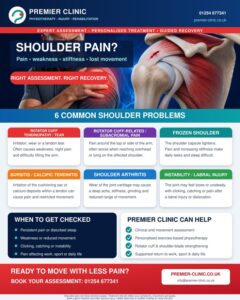
SHOULDER PAIN ISN’T SOMETHING YOU JUST HAVE TO LIVE WITH
When your shoulder hurts, even the simplest parts of everyday life can become difficult — getting dressed, washing your hair, reaching into a cupboard, driving or finding a comfortable position in bed. Shoulder pain can develop gradually through repetitive movement, work, sport, posture or age-related changes. It can also begin suddenly following a fall, strain or other injury.
Common shoulder conditions include:
✔ Rotator cuff tendinopathy or tear
✔ Shoulder impingement and subacromial pain
✔ Frozen shoulder
✔ Shoulder instability or dislocation
✔ AC joint arthritis
✔ Biceps or calcific tendinitis
✔ Labral tears
✔ Shoulder bursitis
✔ Muscle strains
Although these conditions can produce similar symptoms, they may require very different approaches to recovery. That is why a thorough assessment matters. Signs that your shoulder may need professional attention include:
⚠️ Pain when lifting or reaching overhead
⚠️ Weakness in the shoulder or arm
⚠️ Increasing stiffness or restricted movement
⚠️ Pain that interrupts your sleep
⚠️ Clicking, catching or a feeling of instability
⚠️ Difficulty working, exercising or completing daily activities
⚠️ Symptoms that are not improving after a few weeks
At Premier Clinic, we look beyond the painful area to understand how your shoulder is moving, what may be contributing to the problem and how it is affecting your everyday life.
Depending on your individual needs, physiotherapy may include:
💙 Pain management and manual therapy
💙 Joint mobilisation
💙 Rotator cuff strengthening
💙 Shoulder-blade stabilisation
💙 Stretching and mobility exercises
💙 Postural and movement correction
💙 Taping or dry needling, when clinically appropriate
💙 A personalised rehabilitation programme
💙 Support returning safely to work, sport and normal activities
There is no single exercise or treatment that is right for every painful shoulder. Your rehabilitation should reflect your condition, symptoms, goals and current level of movement.
Early, evidence-based physiotherapy can help reduce pain, restore strength and mobility, improve shoulder function and reduce the risk of the problem becoming persistent.
Don’t just put up with shoulder pain. Let’s find out what is happening and help you move forward.
📞 Book an assessment: 01254 677341
📧 info@premier-clinic.co.uk
🌐 premier-clinic.co.uk
Seek urgent medical attention following a serious injury, visible deformity or sudden inability to move your arm.
#PremierClinic #ShoulderPain #Physiotherapy #RotatorCuff #FrozenShoulder #ShoulderRehabilitation #SportsInjury #PainManagement
Diabetic Foot Care
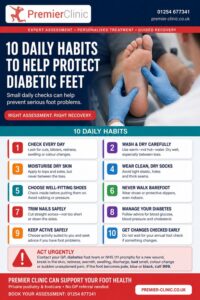
👣 10 daily habits to help protect diabetic feet
Daily foot care is an important part of diabetes management. Diabetes can affect sensation, circulation and the body’s ability to heal, meaning a small cut, blister or pressure point can become more serious if it is not noticed early.
Simple daily habits can help protect the skin, reduce pressure and friction, and identify warning signs before complications develop:
✅ Inspect your feet for cuts, blisters, redness, swelling or colour changes
✅ Wash and dry them carefully, especially between the toes
✅ Moisturise dry skin—but not between the toes
✅ Wear clean, dry socks and properly fitted, supportive footwear
✅ Avoid walking barefoot
✅ Manage your blood glucose as advised
✅ Report wounds or concerning changes promptly
Daily checks are particularly important for people with diabetic neuropathy, as reduced sensation can make an injury difficult to feel. A blister, crack or small wound may worsen without causing significant pain.
Persistent redness, warmth, swelling, discharge, an unpleasant smell, skin breakdown or a wound that is not healing should never be ignored. Contact your GP, diabetes foot team or NHS 111 promptly.
Consistent care, early detection, suitable footwear, good diabetes management and regular foot assessments can help reduce the risk of ulcers, infections and other serious complications.
Premier Clinic provides private podiatry assessments and ongoing foot care, with no GP referral needed.
📞 01254 677341
🌐 premier-clinic.co.uk
#DiabeticFootCare #DiabetesAwareness #FootHealth #Podiatry #PeripheralNeuropathy #PremierClinic #Blackburn
Private GP Women’s Health Services in Blackburn: What Can You Book?
Getting a GP appointment in Blackburn for a women’s health concern is not always straightforward. NHS appointments are short, waiting times for referrals are long, and some women simply prefer the privacy and pace of a private consultation to discuss matters that feel personal. Premier Clinic at Lions Drive, Shadsworth Business Park, Blackburn offers a full range of private GP women’s health services, including cervical screening, menopause and HRT consultations, hormone testing, and comprehensive women’s health checks, all with a female GP and no waiting list.
This article explains every women’s health service available at Premier Clinic’s private GP service in Blackburn, what each involves, and how to book.
Who Provides the Women’s Health Services at Premier Clinic?
Dr Clare Tattersall is the private GP at Premier Clinic. She qualified from Barts Medical School in London in 2008 and completed her GP training in 2013. She is registered with the General Medical Council and has extensive experience across women’s health including menopause management, HRT prescribing, cervical screening, contraception review, and general women’s health assessment. She is a supportive and thorough clinician who provides the time that NHS appointments often cannot.
Dr Tattersall is a female GP. For many women this matters, particularly for intimate examinations, cervical screening, or sensitive discussions about menopause, hormone health, and sexual wellbeing. All consultations are confidential.
Premier Clinic’s private GP appointments are available in 30-minute and 45-minute slots, giving Dr Tattersall the time to discuss your concerns properly without the pressure of a ten-minute NHS appointment. A 15-minute slot is available for specific services such as repeat prescriptions.
Women’s Health Services You Can Book at Premier Clinic Blackburn
Private Cervical Screening in Blackburn
Cervical screening, commonly called a smear test, checks for changes in the cells of the cervix that could develop into cervical cancer if left untreated. The NHS invites women aged 25 to 64 for cervical screening every three to five years. However, many women prefer to have more frequent screening, or need a test outside of the NHS schedule, and can access private cervical screening at Premier Clinic without waiting for an NHS invitation.
Private cervical screening is also an option for women who have found the NHS process difficult or who want the reassurance of a more relaxed, private setting. At Premier Clinic, cervical screening is performed by Dr Tattersall and the sample is sent to an accredited laboratory with results communicated promptly and confidentially.
Women under 25 are not eligible for the NHS Cervical Screening Programme, but if a woman under 25 has concerns about her cervical health, this can be discussed during a private GP consultation at Premier Clinic. Learn more about cervical screening from NHS guidance on cervical screening.
Many women choose to book private cervical screening in Blackburn because they want annual checks rather than waiting three to five years between NHS invitations, or because they were not invited at the expected time and want to arrange their own appointment. Premier Clinic accommodates both.
Menopause and HRT Consultation in Blackburn
Menopause typically occurs between the ages of 45 and 55 and is characterised by a gradual decrease in oestrogen. Early symptoms can include poor sleep, hot flushes, irregular periods, vaginal dryness, reduced libido, mood changes, and weight gain. Perimenopause, the transitional period before menstrual periods stop completely, can produce similar symptoms for several years before the menopause itself.
At Premier Clinic, Dr Tattersall offers dedicated menopause consultations for women in Blackburn and across Lancashire. These consultations cover:
- Discussion of symptoms and their impact on daily life, work, and relationships
- Assessment of hormone levels through blood testing, arranged on the same site through Premier Clinic’s diagnostic and blood testing service
- Discussion of hormone replacement therapy (HRT), including the different types, routes of administration, benefits, and risks in the context of the patient’s personal and family health history
- HRT prescribing where clinically appropriate
- Non-hormonal management options for women who cannot or prefer not to use HRT
- Advice on lifestyle, nutrition, and exercise in relation to menopause symptoms
- Follow-up to review response to treatment and adjust as needed
For women who are uncertain whether their symptoms are menopausal, Dr Tattersall can arrange hormone blood tests as part of the consultation to help inform the diagnosis and treatment discussion. The NICE guideline on menopause (NG23) supports the use of HRT as an effective treatment for menopausal symptoms and Dr Tattersall’s practice is aligned with current evidence-based guidance.
Women’s Health Check in Blackburn
A private women’s health check at Premier Clinic is a comprehensive review of a woman’s overall health, carried out by Dr Tattersall at a pace that allows proper discussion of any concerns. The check can be tailored to the woman’s age, family history, and current health priorities, and typically includes:
- Full medical history review and discussion of current symptoms or health concerns
- Blood pressure and cardiovascular risk assessment
- Blood tests as clinically indicated, including full blood count, thyroid function, cholesterol, HbA1c, hormone levels, vitamin D, and iron
- BMI and metabolic health assessment
- Discussion of family history of conditions including breast cancer, ovarian cancer, cervical cancer, and cardiovascular disease
- Cervical screening if due or requested
- Referrals for mammography, ultrasound, or specialist review where indicated
- Lifestyle and preventive health advice tailored to the patient’s age and risk profile
Hormone Blood Testing for Women
Blood testing is available at Premier Clinic without a GP referral. For women’s health specifically, the following hormone and related panels are commonly requested:
| Test | What It Assesses | Relevant For |
| FSH and LH | Follicle-stimulating and luteinising hormones indicating menopause onset | Perimenopause, menopause assessment |
| Oestradiol | Main oestrogen, declines during menopause | Menopause, HRT monitoring, fertility concerns |
| Progesterone | Produced after ovulation, low levels indicate irregular cycles | Cycle irregularity, fertility |
| Testosterone | Relevant for libido, energy, and mood in women | Low libido, fatigue, mood changes |
| Thyroid (TSH, free T3, free T4) | Thyroid function affecting weight, mood, energy, and cycles | Fatigue, weight change, mood disorders |
| Full blood count | Anaemia, infection, general health markers | Heavy periods, fatigue, general check |
| Vitamin D | Bone health, immune function, mood | Fatigue, bone health, general wellbeing |
| HbA1c and fasting glucose | Diabetes and insulin resistance | Weight gain, polycystic ovary syndrome, general health |
| Cholesterol and lipid panel | Cardiovascular risk, especially important post-menopause | Cardiovascular health, HRT decision-making |
| CA125 | Ovarian cancer marker, not diagnostic but monitored in higher-risk women | Family history, pelvic symptoms, GP decision |
Contraception Review and Advice
Dr Tattersall can review current contraception, discuss options where a change is being considered, prescribe oral contraception, and advise on the interaction between contraception and other health considerations including perimenopause and HRT. A contraception review appointment is typically 30 minutes.
Vaginal and Pelvic Health Concerns
Vaginal dryness, pelvic pain, changes in discharge, or other intimate health concerns can be discussed with Dr Tattersall in a private, non-rushed consultation. Where physical examination or swabs are clinically indicated, these can be arranged as part of the appointment. Referrals to gynaecology or genitourinary medicine can be arranged where specialist review is needed.
Mental Health and Emotional Wellbeing
Anxiety, low mood, and sleep difficulties associated with perimenopause and menopause are as clinically significant as the physical symptoms. Dr Tattersall addresses these as part of the overall menopause consultation rather than treating them as separate concerns. Where ongoing psychological support is beneficial, Premier Clinic’s BACP-accredited counselling service is available on the same site. Sarah, the clinic’s counsellor, works with women experiencing anxiety, depression, grief, and the emotional dimensions of health transitions including menopause.
Weight Management and Exercise After Menopause
Weight gain associated with menopause is a common concern and is driven by changes in oestrogen and progesterone that alter metabolism and body composition. Dr Tattersall can discuss the clinical dimensions of weight management, including the role of HRT in reducing metabolic changes associated with menopause. Premier Clinic’s personal training service, led by Lynnsey Worsley who brings a background in NHS dietetic support, offers clinically informed exercise programmes for women managing weight and fitness through and after menopause.
Why Book Private Women’s Health Care at Premier Clinic in Blackburn?
A Female GP Who Listens
Women’s health concerns, and in particular menopause and intimate health, deserve the time, privacy, and sensitivity that NHS appointments rarely provide. Dr Tattersall’s 30 and 45-minute consultation formats, combined with her clinical experience and her specific interest in women’s health, create the conditions for a proper conversation. Patients leave with a clear understanding of what has been found, what the options are, and what the agreed plan is.
No Waiting List and Same-Week Appointments
NHS waiting times for women’s health concerns including menopause management, cervical screening rescheduling, and gynaecological referrals have lengthened substantially in recent years. Premier Clinic offers appointments typically within one week, with no GP referral needed and no requirement to be registered with the clinic beforehand.
Blood Tests and Diagnostics on the Same Site
One of the most clinically useful aspects of Premier Clinic’s private GP service is that blood testing and diagnostics are available on the same site. Dr Tattersall can request hormone panels, thyroid function, full blood count, or any other relevant investigation during the consultation itself, and results are returned promptly for review. Imaging referrals including ultrasound and MRI can be arranged quickly through the private pathway.
Access to the Full Premier Clinic Team
Women attending Premier Clinic for a GP appointment also have access, where relevant, to the clinic’s wider team. Physiotherapy and rehabilitation through the physiotherapy service for musculoskeletal problems associated with hormone decline. Podiatry for foot and lower limb conditions. Personal training for post-menopause fitness and weight management. Counselling for emotional health. All are available from the same address at Premier Clinic’s Lions Drive site without external referral.
Transparent Pricing, No Upsell
Premier Clinic publishes its pricing openly on the price list page. Patients know the cost of their appointment before they arrive. There are no hidden charges and no pressure to book additional services. Clinical recommendations are made because they are appropriate, not because they generate revenue.
Private Women’s Health in Blackburn vs NHS: A Practical Comparison
| Factor | NHS GP Service Blackburn | Premier Clinic Private GP |
| Appointment wait time | Days to weeks depending on urgency | Typically within one week |
| Appointment duration | 10 minutes standard | 30 or 45 minutes |
| Female GP available | Depends on practice and availability | Yes, Dr Clare Tattersall |
| Cervical screening | By NHS invitation schedule | Any time, on request, private |
| Menopause consultation | Short appointment, often multiple visits needed | Dedicated 30 or 45-minute appointment |
| HRT prescribing | Available but can involve multiple appointments | Discussed and prescribed in one consultation where appropriate |
| Hormone blood tests | Arranged via GP referral, wait for results | Arranged on site, prompt results |
| Imaging referrals | NHS waiting times apply | Private referral arranged quickly |
| Referral needed to access | No, registered patient | No, self-refer directly |
| Counselling on same site | No, separate referral pathway | Yes, BACP-accredited counsellor on site |
| Saturday availability | Limited | Yes, 9am to 1pm |
Frequently Asked Questions: Private GP Women’s Health Blackburn
Q: Can I see a female private GP in Blackburn without a referral?
A: Yes. Premier Clinic operates a self-referral model. Dr Clare Tattersall, a female GMC-registered GP, is available for private women’s health consultations in Blackburn without a GP referral. Call 01254 677341 or email info@premier-clinic.co.uk to book.
Q: Can I get a private smear test in Blackburn outside of the NHS schedule?
A: Yes. Premier Clinic offers private cervical screening in Blackburn at any time, regardless of when you last had an NHS smear test or whether you are due one on the NHS schedule. Many women choose private cervical screening for annual checks, for peace of mind between NHS invitations, or because they prefer a private setting.
Q: What menopause services does Premier Clinic offer in Blackburn?
A: Premier Clinic offers dedicated menopause and HRT consultations with Dr Tattersall, hormone blood testing, HRT prescribing where clinically appropriate, discussion of non-hormonal management, and lifestyle advice. Follow-up appointments to review treatment response are available. Counselling support for the psychological symptoms of menopause is available from the BACP-accredited counsellor on the same site.
Q: How long is a private GP women’s health appointment at Premier Clinic?
A: Appointments are 30 minutes for general consultations, prescriptions, and most women’s health concerns. A 45-minute extended appointment is available for in-depth consultations including menopause assessment, complex health concerns, health screening, or second opinions. A 15-minute slot is available for specific services such as repeat prescriptions.
Q: Can I get hormone blood tests done at Premier Clinic Blackburn?
A: Yes. Blood testing is available at Premier Clinic without a GP referral. Hormone panels for women including FSH, LH, oestradiol, progesterone, testosterone, and thyroid function are available alongside full blood count, vitamin D, HbA1c, and cholesterol. Results are returned promptly and Dr Tattersall can review findings and advise on next steps during a follow-up consultation.
Q: Where is Premier Clinic and how do I book a women’s health appointment?
A: Premier Clinic is at 11 Cunningham Court, Lions Drive, Shadsworth Business Park, Blackburn BB1 2QS. Open Monday to Friday 9am to 6pm and Saturday 9am to 1pm. Free parking on site. Call 01254 677341 or email info@premier-clinic.co.uk to book. No GP referral required.
Book Your Private Women’s Health Appointment at Premier Clinic Blackburn
Whether you need a cervical screening outside of the NHS schedule, a proper conversation about menopause and HRT, hormone blood tests, a comprehensive women’s health check, or simply a GP appointment where you have enough time to discuss what is worrying you, Premier Clinic in Blackburn provides exactly that.
Female GP. No waiting list. Private, unhurried appointments. Blood tests and diagnostics on the same site. Counselling and personal training available when needed. No GP referral required.
Call 01254 677341 to book your private women’s health appointment. Email info@premier-clinic.co.uk. Premier Clinic is at 11 Cunningham Court, Lions Drive, Shadsworth Business Park, Blackburn BB1 2QS. Open Monday to Friday 9am to 6pm and Saturday 9am to 1pm. Free parking on site.
My Knee, Hip or Foot Hurts When I Run: Could My Gait Be the Problem?
You have rested it. You have stretched it. You have tried new shoes, foam rolled every evening, and taken ibuprofen on race day. And it still comes back. The same knee. The same heel. The same hip flexor. Every time you build your mileage past a certain point, the same structure gives way.
This is not bad luck. It is a pattern. And patterns in running injuries almost always have a mechanical explanation.
The way you run, specifically how your foot contacts the ground, how your knee tracks, how your hip drops, and how your trunk rotates, determines which structures carry the most load with every stride. At 40 miles per week that is approximately 70,000 footstrikes on each foot. A small mechanical inefficiency repeated 70,000 times is not small at all. It is a guaranteed injury pathway.
A gait analysis in Blackburn at Premier Clinic identifies that pattern. This article explains how, and what happens when the analysis finds the problem your previous treatment missed.
The Most Common Running Injuries and the Gait Patterns That Drive Them
Most running injuries are not random. Each common injury has a set of biomechanical risk factors that research has consistently associated with it. Understanding which pattern is driving your injury is the first step toward actually fixing it rather than managing it.
Knee Pain When Running: Runner’s Knee and IT Band Syndrome
Patellofemoral pain, called runner’s knee, is the most common running injury. The kneecap sits in a groove in the femur and glides through it as the knee bends and straightens. When the soft tissue structures around the knee are not balanced, the kneecap tracks abnormally within that groove, creating friction and pain. The most common biomechanical driver is excessive foot pronation producing tibial internal rotation, which pulls the patella medially. Hip abductor weakness compounds this by allowing the hip to drop during single-leg stance, increasing knee valgus and patellar stress.
IT band syndrome produces pain on the outer side of the knee and is similarly driven by hip weakness and gait mechanics. Runners whose hips drop excessively during the stance phase place repetitive tension on the iliotibial band as it crosses the knee. The pain is caused by gait, not by the IT band itself, which is why foam rolling the band in isolation produces temporary relief at best.
Hip Pain When Running: Gluteal Tendinopathy and Hip Flexor Strain
Hip pain in runners most commonly involves the gluteal tendons on the outer hip or the hip flexor complex at the front of the hip. Gluteal tendinopathy is driven by compressive loads on the tendon, which occur when the hip adducts in excess during the stance phase of gait. This is the same hip drop pattern that drives runner’s knee, which is why the two injuries frequently co-exist in the same runner. Hip flexor strain is typically a load management problem, but the mechanics of how a runner extends the hip during the late stance phase determine the tissue stress. An overstriding pattern that produces a long, low-impact footstrike in front of the body loads the hip flexors differently to a well-positioned footstrike beneath the body’s centre of mass.
Foot Pain When Running: Plantar Fasciitis and Metatarsalgia
Plantar fasciitis is the running world’s most persistent injury. The plantar fascia, the thick band of tissue running from the heel to the toes, absorbs enormous load during running. When the foot mechanics increase the strain at the fascia’s heel insertion, the repetitive loading exceeds the tissue’s capacity to adapt and breakdown occurs. Excessive pronation, a flat arch, and restricted ankle dorsiflexion are the three most common biomechanical contributors. Metatarsalgia, pain in the ball of the foot, typically reflects elevated forefoot pressure during the propulsive phase, which a pressure plate footscan quantifies precisely.
Shin Splints and Stress Fractures
Medial tibial stress syndrome, commonly called shin splints, is caused by repetitive bending stress in the tibia. The magnitude of that bending stress is directly influenced by how the foot loads the ground. Excessive and rapid pronation generates higher tibial bending forces with each footstrike. A runner whose foot collapses inward rapidly on landing is generating more tibial stress per mile than a runner with controlled mechanics, even at the same pace and volume. When tibial bending stress exceeds the bone’s remodelling capacity, the result is first a stress reaction and then a stress fracture.
Achilles Tendinopathy
The Achilles tendon is under highest rotational stress at the heel-lift phase of gait, when the foot transitions from pronation to supination during propulsion. Runners who overpronate impose higher rotational torque on the tendon at this critical moment. The clinical consequence is collagen disruption in the midportion of the tendon that presents as the classic Achilles tendinopathy: pain in the morning after rest, pain at the beginning of a run that often settles midway through, and then a gradual worsening as training volume increases.
Every injury described above has a biomechanical contributor that a gait analysis identifies. In many cases, runners have been treated for the tissue problem without anyone ever assessing the mechanical pattern that keeps recreating it. Addressing the tissue without the mechanics produces recovery followed by relapse, not resolution.
What a Running Gait Analysis at Premier Clinic Blackburn Involves
Premier Clinic’s running clinic and biomechanics service in Blackburn provides a full clinical gait analysis, not a retail shoe assessment. There is a meaningful difference. A free gait analysis at a running shop produces a shoe recommendation. A clinical gait analysis at Premier Clinic produces a diagnosis, a biomechanical report, and a treatment plan.
Clinical History and Injury Assessment
The assessment begins with a detailed discussion of your training history, the nature and onset of your injury, what makes it better and worse, what you have already tried, and what your running goals are. This history frequently points toward the cause before the physical examination begins. A runner who always injures the same leg, whose symptoms worsen as weekly mileage increases, and who has a history of wearing shoes down on the outer heel is already providing biomechanical data.
Musculoskeletal Examination
A physical examination assesses foot posture and arch structure, ankle range of motion, hip strength and mobility, leg length, and any structural findings relevant to the injury. Specific clinical tests assess the integrity of the tissues involved in the injury and identify any muscular weaknesses that contribute to the gait pattern.
Video Gait Analysis at Running Speed
The runner walks and runs on a treadmill while video analysis captures movement from the front and side at multiple camera angles. The clinician assesses foot strike pattern, the rate and degree of pronation, tibial rotation, knee valgus angle, hip drop during single-leg stance, trunk lean, arm swing, and cadence. Running gait captures information that walking gait does not, because the forces involved are two to three times higher and movement patterns that are controlled at walking speed often break down at running speed. This is why a clinical gait analysis at Premier Clinic captures running data, not just walking data.
Force Plate and Dynamic Footscan
For runners being assessed for custom orthotic prescription, a dynamic footscan using force plate technology captures real-time pressure distribution during the footstrike cycle. The result is a pressure map showing exactly where the foot loads the ground, when, and with how much force. This data drives the Phits orthotic prescription and is far more clinically relevant than a static foam box impression of the foot at rest.
Biomechanical Report and Treatment Plan
Following the assessment, a written biomechanical report is produced. The report identifies the specific gait parameters contributing to the injury, quantifies them where possible, and proposes a structured treatment plan. The plan specifies which interventions are indicated, the order in which they should be implemented, and the expected timeline for each stage of recovery and return to running.
What Gait Analysis Finds in Runners: The Most Common Patterns
| Gait Pattern | What It Means | Injury It Drives | Intervention |
| Excessive pronation | Foot collapses inward too far or too fast after heel contact | Plantar fasciitis, runner’s knee, Achilles tendinopathy, shin splints | Custom orthotics, footwear assessment, hip strengthening |
| Contralateral hip drop | Pelvis drops on the non-stance side during single-leg support | IT band syndrome, gluteal tendinopathy, runner’s knee | Hip abductor strengthening, gait retraining |
| Knee valgus on loading | Knee collapses inward during stance phase | Patellofemoral pain, IT band syndrome | Hip and glute strengthening, orthotics, gait retraining |
| Overstriding | Foot lands well ahead of centre of mass | Shin splints, hip flexor strain, knee pain | Cadence increase, gait retraining, run technique work |
| Heel whip | Foot swings outward or inward during swing phase | Knee pain, IT band syndrome, hip pain | Hip mobility work, gait retraining |
| Reduced ankle dorsiflexion | Ankle cannot flex sufficiently, forcing compensation | Plantar fasciitis, Achilles tendinopathy, knee pain | Calf stretching and loading programme, heel raise in orthotics |
| Asymmetric arm swing | One arm crosses the midline, rotating the trunk | Lower back pain, hip pain, shoulder pain during running | Run technique correction, core stability work |
| Low cadence | Fewer steps per minute, longer ground contact time, more impact | Shin splints, stress fractures, knee pain | Metronome-based cadence training, gait retraining |
How Gait Problems Are Treated at Premier Clinic Blackburn
Identifying a gait problem is the first step. Correcting it requires specific interventions that address the specific pattern. At Premier Clinic, the following treatments are available on the same site and are co-ordinated as a single programme.
Custom Orthotics for Runners
Where foot mechanics contribute to the injury, custom orthotics address the problem at its source. Premier Clinic prescribes Phits 3D-printed orthotics, produced from dynamic footscan data to a tolerance of 0.1mm by Materialise, the world leader in medical 3D printing. Unlike cast-based orthotics that record a static foot position, Phits orthotics are designed from data captured during actual gait, which is more clinically relevant for runners whose foot mechanics change significantly under load.
Running-specific orthotic variants are available for road and trail running shoes, football boots, cycling cleats, and other sport-specific footwear. The prescribing podiatrist specifies material, density, design profile, and top cover based on the gait analysis findings and the patient’s training demands.
Physiotherapy and Targeted Strengthening
Most gait problems in runners have a muscular weakness component. Hip abductor and gluteal weakness is among the most common, and it directly drives multiple injury patterns including IT band syndrome, runner’s knee, and gluteal tendinopathy. The physiotherapy service at Premier Clinic designs a targeted strengthening programme based on the specific weaknesses identified during the gait assessment. This is not a generic hip strengthening programme. It is a programme specific to the muscles that are weak in this runner, causing this gait pattern, producing this injury.
Shockwave Therapy for Chronic Tissue Damage
Runners who have been managing the same tendon injury for weeks or months often have chronic tissue changes that require more than load management and strengthening to resolve. Shockwave therapy at Premier Clinic stimulates cellular repair in chronically degenerated tendon tissue, accelerating the biological repair process alongside the mechanical correction of the gait pattern driving the injury. Both radial and focused shockwave are available, with the prescribing clinician selecting the appropriate technology based on the location and nature of the tissue pathology.
Sports Massage for Soft Tissue Recovery
Running injuries typically produce secondary soft tissue adaptations: tight calf muscles, tensor fasciae latae hypertonicity, inhibited glutes, and fascial restrictions that develop as the body compensates around the injured structure. Sports massage at Premier Clinic addresses these secondary changes, reducing tissue tension that would otherwise limit the effectiveness of the strengthening programme and gait retraining.
AlterG Treadmill for Maintaining Fitness During Recovery
One of the most common and legitimate fears runners have about injury is losing fitness during recovery. For runners with stress fractures, plantar fascia tears, or post-surgical lower limb conditions, complete rest from running means cardiovascular deconditioning that can take months to recover. Premier Clinic’s AlterG Anti-Gravity Treadmill solves this directly. By reducing effective body weight to as little as 20% during treadmill running, the AlterG allows injured runners to continue training at meaningful aerobic intensities while the healing tissue is protected from the full mechanical loads that caused the injury. Premier Clinic is one of the only clinics in Lancashire with this equipment on site.
Gait Retraining
Where the gait problem involves movement patterns that orthotics and strengthening alone cannot fully correct, structured gait retraining is used. This involves the runner practising modified movement patterns with real-time feedback from video analysis until the new pattern becomes automatic. Common retraining targets include increasing cadence, reducing overstriding, limiting contralateral hip drop, and improving forward lean. Return-to-running protocols are designed through the running clinic and combined with the rehabilitation programme to guide the runner back to full training volume safely.
Signs Your Running Pain Is a Gait Problem, Not Just a Tissue Problem
- The same injury keeps returning in the same location despite rest and previous treatment
- Pain only occurs above a certain weekly mileage threshold
- The injury is always on the same side of the body
- You wear your running shoes down faster on one side or in a consistent unusual pattern
- You have had the same injury diagnosed and treated by multiple clinicians without lasting resolution
- Your symptoms are worse on certain terrain or surface types
- Friends or other runners have commented on something unusual about the way you run
- You have changed shoes multiple times to address the problem without success
- Your injury returns every time you increase training load toward a race
If three or more of the above apply to you, your injury almost certainly has a gait or biomechanical component that has not been assessed. Managing the tissue without assessing the mechanics that are breaking it down is not a treatment. It is a maintenance programme for a problem that will continue indefinitely until the cause is addressed.
Sports Podiatry in Blackburn: The Role of the Foot in Running Injuries
Sports podiatry is the discipline that sits at the intersection of foot function and athletic performance. A sports podiatrist does not simply treat foot pain. They assess how the foot mechanics during running and sport interact with the entire lower limb kinetic chain, and they intervene to correct patterns that are driving injury above and below the foot.
At Premier Clinic, the sports podiatry service is led by Shaun Kelly, who holds a Masters-level qualification in musculoskeletal medicine, sports podiatry, and biomechanics, with over 20 years of post-graduate clinical experience. The combination of podiatric training and musculoskeletal medicine means that the assessment spans from the foot mechanics to the hip and spine, rather than stopping at the ankle.
Sports podiatry at Premier Clinic covers:
- Running gait analysis and biomechanical assessment
- Custom sports orthotics using Phits 3D technology and force plate data
- Footwear assessment and recommendations specific to the runner’s foot type and gait
- Sport-specific orthotic prescription for road running, trail running, football, cycling, and other sports
- Foot and lower limb injury assessment and treatment
- Swift verruca treatment for runners who cannot afford downtime from skin lesion management
- Nail and skin conditions common in runners, including subungual haematoma and friction blisters
Frequently Asked Questions: Running Gait Analysis in Blackburn
Q: How do I know if my running injury is caused by my gait?
A: The clearest indicators are that the same injury keeps returning in the same location, that it comes back every time you increase your training load, that it is always on the same side, and that previous treatment has produced temporary improvement but not lasting resolution. Any of these patterns suggests that the mechanical cause of the injury has not been identified or addressed. A gait analysis at Premier Clinic Blackburn will identify whether your running mechanics are contributing to the problem.
Q: What does a running gait analysis at Premier Clinic Blackburn involve?
A: The assessment includes a clinical history and injury review, a musculoskeletal examination of the foot, ankle, knee, hip, and pelvis, video gait analysis at both walking and running speed from multiple angles, and where custom orthotics are being considered, a dynamic footscan using force plate technology. The assessment produces a written biomechanical report and a personalised treatment plan. Appointments are typically available within one week and no GP referral is needed.
Q: Can custom orthotics fix running knee pain?
A: Custom orthotics can be a significant part of the solution for runner’s knee when excessive foot pronation is driving the tibial rotation and knee valgus that produces patellofemoral pain. They are rarely the complete solution on their own. Most runners with knee pain also need a targeted hip strengthening programme to address the weakness that allows knee valgus to occur. At Premier Clinic, orthotics and physiotherapy are co-ordinated as part of a single treatment plan rather than implemented in sequence by separate providers.
Q: How long does it take to fix a running gait problem?
A: Orthotic prescription produces changes in ground contact mechanics from the first use. Strength improvements from a targeted rehabilitation programme typically become functionally significant within six to eight weeks. Gait retraining to change habitual movement patterns takes longer and is typically consolidated over ten to sixteen weeks of consistent practice. The timeline for return to full training volume depends on the nature and duration of the injury as well as the severity of the gait problem. Premier Clinic provides a realistic timeline at the initial assessment and reviews it as recovery progresses.
Q: Is Premier Clinic’s running gait analysis different from a free gait analysis at a running shop?
A: Yes, significantly. A running shop gait assessment is a retail process designed to recommend footwear. It is performed by sales staff, not clinicians, typically lasts five to ten minutes, and produces a shoe recommendation. A clinical gait analysis at Premier Clinic is conducted by an HCPC-registered podiatrist with specialist biomechanics training, includes a full musculoskeletal examination, uses force plate and video technology, and produces a clinical report with a structured treatment plan. The two processes are not comparable.
Q: Do I need a GP referral for a running gait analysis in Blackburn?
A: No. Premier Clinic operates a self-referral model for all biomechanics, running clinic, and sports podiatry services. Call 01254 677341 or email info@premier-clinic.co.uk to book directly.
Book Your Running Gait Analysis at Premier Clinic Blackburn
If the same knee, hip, or foot problem keeps interrupting your running, the answer is almost certainly not more rest, more foam rolling, or a different pair of shoes. The answer is finding out why that specific structure keeps failing under the specific demands of your running, and then changing the mechanical environment that keeps breaking it down.
Premier Clinic at Lions Drive, Blackburn provides running gait analysis, sports podiatry, biomechanics assessment, custom orthotics, physiotherapy, shockwave therapy, and AlterG rehabilitation from one site, with one clinical team. No GP referral needed. Appointments available within the week. Saturday mornings available.
Call 01254 677341 or email info@premier-clinic.co.uk to book your running gait analysis. Premier Clinic is at 11 Cunningham Court, Lions Drive, Shadsworth Business Park, Blackburn BB1 2QS. Open Monday to Friday 9am to 6pm and Saturday 9am to 1pm. Free parking on site.

Private Health Clinic in Blackburn BB1 for Physiotherapy, Podiatry and Diagnostics
Finding a private health clinic in Blackburn BB1 that goes beyond a single service is genuinely difficult. Most private clinics in the area offer one discipline: physiotherapy, or podiatry, or massage. Patients who need more than one of these, or who need clinical investigation alongside treatment, end up managing their own care across multiple providers with no communication between them.
Premier Clinic at Lions Drive, Shadsworth Business Park, Blackburn BB1 2QS is built to solve that problem. As a fully integrated private health clinic in Blackburn BB1, Premier Clinic provides physiotherapy, podiatry, sports rehabilitation, medical diagnostics, private GP consultations, biomechanics assessment, shockwave therapy, AlterG treadmill rehabilitation, and more under one roof, with one clinical team and one shared record. No GP referral needed for any service.
Physiotherapy at Premier Clinic: Blackburn BB1’s Private Physio Clinic
Premier Clinic’s physiotherapy service is delivered by Greta, an HCPC-registered physiotherapist who trained to BSc level and holds full registration verifiable on the HCPC public register. She works full time at Premier Clinic and is a member of the Chartered Society of Physiotherapy.
Every physiotherapy patient begins with a thorough clinical assessment before any treatment is applied. The assessment establishes a formal diagnosis, identifies the contributing factors, and produces a personalised treatment plan with realistic milestones. Appointments are 45 to 60 minutes, giving the time that NHS appointments of ten to twenty minutes cannot. Physiotherapy at Premier Clinic treats:
- Back pain, neck pain, and spinal conditions
- Shoulder, knee, hip, and ankle injuries
- Post-surgical rehabilitation following joint replacement, ACL reconstruction, rotator cuff repair, and spinal surgery
- Sports injuries and overuse conditions
- Neurological conditions including Parkinson’s disease and stroke rehabilitation
- Occupational injuries and work-related musculoskeletal disorders
- Chronic pain conditions
For post-surgical patients, Premier Clinic’s AlterG Anti-Gravity Treadmill is available on site, one of the only rehabilitation clinics in Lancashire to offer this. It uses NASA-derived differential air pressure to reduce effective body weight to as little as 20%, allowing gait training and cardiovascular conditioning to begin weeks before full weight-bearing is clinically safe. Full rehabilitation programmes are available through the rehabilitation service for patients requiring a structured, multi-stage recovery pathway.
Private physiotherapy at Premier Clinic in Blackburn BB1 is typically available within one to two working days of booking. There is no GP referral needed and no NHS waiting list. Saturday appointments are available from 9am to 1pm.
Podiatry at Premier Clinic: Private Podiatry in Blackburn BB1
Premier Clinic’s podiatry and foot care service is led by Shaun Kelly, who holds a Masters-level qualification in musculoskeletal medicine, sports podiatry, and biomechanics and brings over 20 years of post-graduate clinical experience. He is HCPC-registered and a member of the Royal College of Podiatry.
The podiatry service covers the full range of foot and lower limb conditions:
- Nail conditions including ingrown toenails, thickened nails, and nail surgery
- Skin conditions including corns, calluses, and verrucas
- Swift microwave verruca treatment, the most clinically advanced verruca removal technology available in Blackburn, with clearance rates of up to 86% in clinical studies
- Diabetic foot assessment and pressure management
- General chiropody and routine foot care
- Sports podiatry for athletes and active adults
Physio and Podiatry in Blackburn: Why Combined Access Changes Outcomes
Many lower limb conditions need both disciplines. Plantar fasciitis requires podiatric management of foot mechanics and orthotic therapy alongside physiotherapy-directed calf strengthening and progressive loading. Runner’s knee is driven by foot pronation that the podiatrist addresses through orthotics and by hip weakness that the physiotherapist addresses through targeted rehabilitation. At Premier Clinic, physio and podiatry in Blackburn share clinical records and communicate about shared patients, producing treatment plans that reflect the whole picture rather than separate parts of it.
The Royal College of Podiatry’s Musculoskeletal Capability Framework specifically supports closer collaboration between podiatrists and physiotherapists in treating lower limb conditions. Premier Clinic’s founder is trained in both disciplines. This combined approach is the clinical foundation of the clinic, not a commercial convenience.
Biomechanics and Custom Orthotics at Premier Clinic BB1
Premier Clinic’s biomechanics and orthotics service uses force plate technology, video gait analysis, and dynamic footscan data to assess how a patient moves and identify the specific mechanical factors driving pain or injury. Custom orthotics are prescribed and manufactured using two technologies:
- Phits 3D-printed orthotics, produced from dynamic footscan data to a tolerance of 0.1mm by Materialise, the world leader in medical 3D printing
- Cast-based custom orthotics via Fit4U for presentations requiring a traditional manufacturing approach
An orthotic refurbishment service is also available for patients whose existing devices need top cover replacement. The running clinic extends this into sport-specific gait analysis and return-to-running assessment for runners and field sport athletes.
Medical Diagnostics in Blackburn at Premier Clinic
Medical diagnostics at Premier Clinic BB1 go well beyond what a standard physiotherapy or podiatry clinic can offer, because Premier Clinic also has an on-site GMC-registered private GP.
Private GP at Premier Clinic BB1
Dr Clare Tattersall qualified from Barts Medical School in London in 2008 and completed her GP training in 2013. She provides private GP consultations at Premier Clinic in 30-minute and 45-minute appointment slots. As a GMC-registered practitioner, Dr Tattersall can:
- Arrange blood tests and review results on the same site
- Refer for ultrasound, MRI, CT, and X-ray through the private imaging pathway
- Write private prescriptions
- Provide second opinions on NHS diagnoses
- Manage women’s health including menopause, HRT, and cervical screening
- Manage men’s health including testosterone and cardiovascular risk
- Co-ordinate care with NHS colleagues where appropriate
Blood Tests and Medical Testing
Premier Clinic offers a comprehensive range of private blood tests and medical diagnostics through its medical testing service. Testing available includes full blood count, liver and kidney function, thyroid panel, HbA1c and glucose, cholesterol and cardiovascular risk, hormone panels for men and women, vitamin D and B12, inflammatory markers, and sports-specific panels for athletes. Cervical screening is also available. Results are returned promptly with GP review available on the same site.
Audiometric Hearing Tests and Ear Wax Removal
Premier Clinic’s hearing clinic provides full audiometric hearing assessments and ear wax removal via microsuction, performed by qualified audiologists. Industrial hearing screening for employers across Lancashire is available through the industrial hearing screening service.
Occupational Health
Premier Clinic provides fitness-for-work assessments, health surveillance, and management referrals for employers across Blackburn and Lancashire. Return-to-work documentation and independent medico-legal injury reports are available through the medico-legal service.
No other private clinic in Blackburn BB1 combines physiotherapy, podiatry, biomechanics assessment, a private GP, blood testing, audiometric hearing assessment, occupational health, and medico-legal reporting under one roof. Premier Clinic is unique in the BB1 postcode and across the broader Lancashire area.
Additional Clinical Services at Premier Clinic Blackburn BB1
| Service |
What It Provides
|
| Sports injury and massage |
Deep tissue massage, sports massage, cupping, therapeutic soft tissue treatment for athletes and active adults
|
| Shockwave and laser therapy |
Radial and focused ESWT for plantar fasciitis, Achilles tendinopathy, tennis elbow, and chronic tendon conditions
|
| AlterG anti-gravity treadmill |
Gravity-reduced rehabilitation for post-surgical patients, neurological conditions, and injured athletes
|
| Personal training |
Clinically supervised conditioning, weight loss, and return-to-gym rehabilitation led by Lynnsey Worsley
|
| Counselling |
BACP-accredited individual, couple, and family counselling with Sarah, integrative approach
|
| Bespoke footwear |
Custom-made shoes for problem feet, diabetic footwear, Reed Medical footwear designed and made in Blackburn
|
| Men’s health |
Shockwave therapy for ED and Peyronie’s disease, hormone assessment, discreet private consultation
|
| Private GP and HRT/menopause |
Full GP consultations, prescriptions, HRT prescribing, women’s and men’s health, second opinions
|
| Services for business |
Occupational health, industrial hearing, medico-legal reporting, health surveillance
|
Why Patients in BB1 and Across Lancashire Choose Premier Clinic
Self-Referral: No GP Letter Needed
Every service at Premier Clinic is accessible without a GP referral. You can book physiotherapy, podiatry, a private GP consultation, blood tests, hearing assessments, or any other service by calling 01254 677341 or emailing info@premier-clinic.co.uk. There are no prerequisites, no waiting lists, and no requirement to be previously registered with the clinic.
All Practitioners Registered With Their Governing Body
All clinical staff at Premier Clinic hold registration with the relevant regulatory body. Physiotherapists and podiatrists are HCPC-registered. The private GP is GMC-registered. The counsellor is BACP-accredited. Registration is publicly verifiable and Premier Clinic encourages patients to check it. All practitioners hold a minimum BSc-level qualification; the head of clinical services holds a Masters-level qualification.
Transparent Pricing and a No-Upsell Policy
Pricing is published openly on the Premier Clinic price list page. There are no hidden charges. Treatments are recommended because they are clinically appropriate, not to maximise revenue. Where multi-session packages offer genuine value, they are offered honestly. 0% finance is available for patients who need to spread the cost of a longer treatment programme.
Saturday Appointments and Free Parking
Premier Clinic is open Monday to Friday 9am to 6pm and Saturday 9am to 1pm. The clinic is at 11 Cunningham Court, Lions Drive, Shadsworth Business Park, Blackburn BB1 2QS, with free on-site parking and straightforward M65 access for patients travelling from Darwen, Accrington, Burnley, Clitheroe, and across East Lancashire.
How Premier Clinic Compares to Other Private Clinics in Blackburn BB1
| Service | Single-Discipline Clinic | Premier Clinic BB1 |
| Physiotherapy | Yes (physio clinics only) | Yes |
| Podiatry | Yes (podiatry clinics only) | Yes |
| Shared clinical records | No | Yes |
| Private GP on site | No | Yes, GMC-registered |
| Blood tests and diagnostics | No | Yes |
| Shockwave therapy | Rarely | Yes, radial and focused ESWT |
| AlterG treadmill | No | Yes, only clinic in Blackburn |
| Biomechanics and Phits orthotics | Rarely | Yes, force plate and 3D printing |
| Counselling on site | No | Yes, BACP-accredited |
| Occupational health | No | Yes |
| No GP referral needed | Yes | Yes, all services |
| Saturday appointments | Varies | Yes, 9am to 1pm |
| 0% finance | No | Yes |
Frequently Asked Questions: Private Health Clinic Blackburn BB1
Q: Where is the private health clinic in Blackburn BB1?
A: Premier Clinic is at 11 Cunningham Court, Lions Drive, Shadsworth Business Park, Blackburn BB1 2QS. Free on-site parking is available and the clinic is accessible from the M65. Open Monday to Friday 9am to 6pm and Saturday 9am to 1pm.
Q: Does Premier Clinic offer physio and podiatry together in Blackburn?
A: Yes. Premier Clinic provides physiotherapy and podiatry from the same site with shared clinical records. Practitioners from both disciplines communicate about shared patients and co-ordinate treatment plans accordingly. This makes Premier Clinic one of the only genuinely integrated physio and podiatry clinics in Blackburn BB1.
Q: What medical diagnostics are available at Premier Clinic Blackburn BB1?
A: Medical diagnostics at Premier Clinic include private blood tests covering haematology, hormones, thyroid, metabolic panels, vitamin levels, and cardiovascular risk; audiometric hearing tests; cervical screening; imaging referrals including ultrasound, MRI, CT, and X-ray through the private GP; and occupational health assessments. All are available without a GP referral.
Q: Do I need a GP referral to use Premier Clinic’s private health services in BB1?
A: No. Premier Clinic operates a self-referral model across all services. Call 01254 677341 or email info@premier-clinic.co.uk to book any service without needing a GP referral or existing registration with the clinic.
Q: Is there a private clinic in Blackburn BB1 with a private GP and physiotherapy on the same site?
A: Yes. Premier Clinic at Lions Drive, Blackburn BB1 2QS has an on-site GMC-registered private GP and an HCPC-registered physiotherapy team. Both services share clinical records, meaning a patient’s physical treatment and medical investigation can proceed in parallel from a single site.
Q: What is the postcode for Premier Clinic in Blackburn?
A: Premier Clinic is at BB1 2QS. The full address is 11 Cunningham Court, Lions Drive, Shadsworth Business Park, Blackburn BB1 2QS.
Book Your Appointment at Premier Clinic Blackburn BB1
If you are searching for a private health clinic in Blackburn BB1 that offers physiotherapy, podiatry, and medical diagnostics without sending you to three different providers, Premier Clinic is the answer. One address. One clinical team. One record. Every relevant service available without a GP referral.
Call 01254 677341 or email info@premier-clinic.co.uk to book. Premier Clinic is at 11 Cunningham Court, Lions Drive, Shadsworth Business Park, Blackburn BB1 2QS. Open Monday to Friday 9am to 6pm, Saturday 9am to 1pm. Free parking on site. 0% finance available.